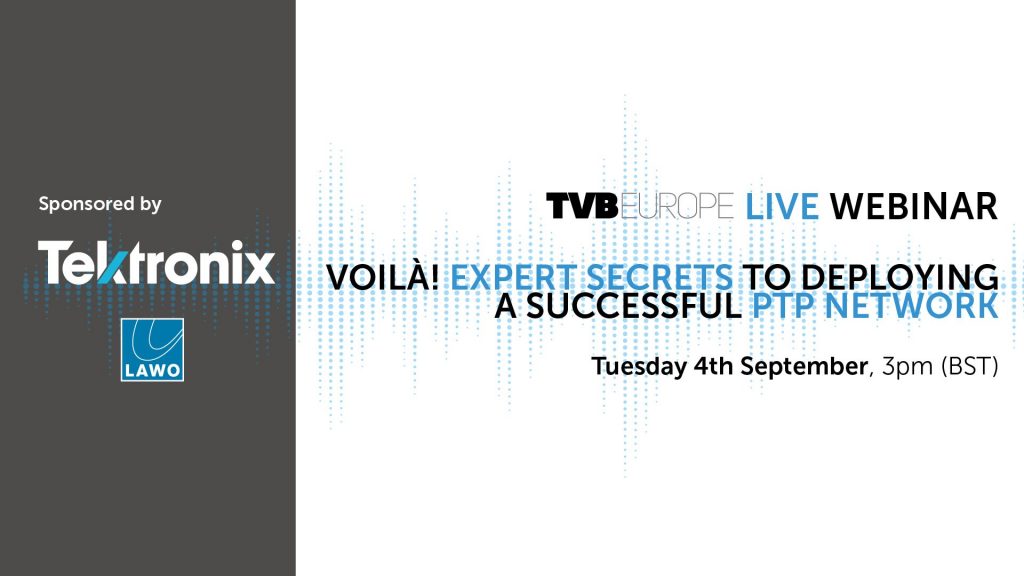
Tuesday 4th September 2018, 15:00 BST
Setting up a PTP Network shouldn’t be difficult! Learn from the experts who have seen it all and know the tricks to keep you out of trouble and your IP network system perfectly timed. This webinar will discuss basic synchronization requirements and how PTP can serve them, provide a high-level view of how to clear PTP obstacles in media applications, and then launch into some monitoring and diagnosis best practices. Come, learn, and ask your toughest questions!

|
Erling Hedkvist SVP and Product Manager for Networked Audio & Video Solutions Lawo |
Erling Hedkvist is Senior Vice President and Business Development Manager at Lawo. Mr Hedkvist has been in the broadcast industry since 2000 and started his career in product management before making the move over to sales, business development and corporate management. Mr Hedkvist specialized early on in providing networking solutions for the broadcast and media & entertainment industry. Initially for contribution applications but lately with a focus on providing software defined networking solutions for live production workflows. As such he works with clients to design complete solutions for Remote Production, Master Control, Playout, PCR, OTT and other broadcast applications on top of IP and in a distributed and virtualized environment.

|
Andreas Hildebrand RAVENNA Evangelist ALC NetworX |
Andreas Hildebrand is acting as Evangelist for the RAVENNA technology developed by ALC NetworX, Germany. His experience is based on more than 25 years of occupation in the Professional Audio / Broadcasting industry. He received a graduate diploma in computer science and worked as a software engineer and Head of Development for companies in Germany and the US for several years. He is a full-time participant in the AES Task Group defining and maintaining the AES67 AoIP standard. He is also participating in the AIMS Technical WG and the SMPTE ST2110 SVIP standardization.

|
Mike Overton Principal Engineer Tektronix |
Mike Overton is a Principal Engineer at Tektronix. He has been a HW designer and project lead on SDI, MPEG, audio, signal generation, picture quality, and IP products. For the last 3 years, Mike has concentrated on IP-based systems, encompassing both the PTP reference and the ST2110 essence aspects. He led the definition and development of the SPG8000A PTP master and contributed to the definition and testing of the Prism IP monitor. He is the focal point for many POCs and recently helped define and execute the SMPTE-sponsored interoperability tests for PTP.
Video: IBC Roundtable – Diversity and Inclusion
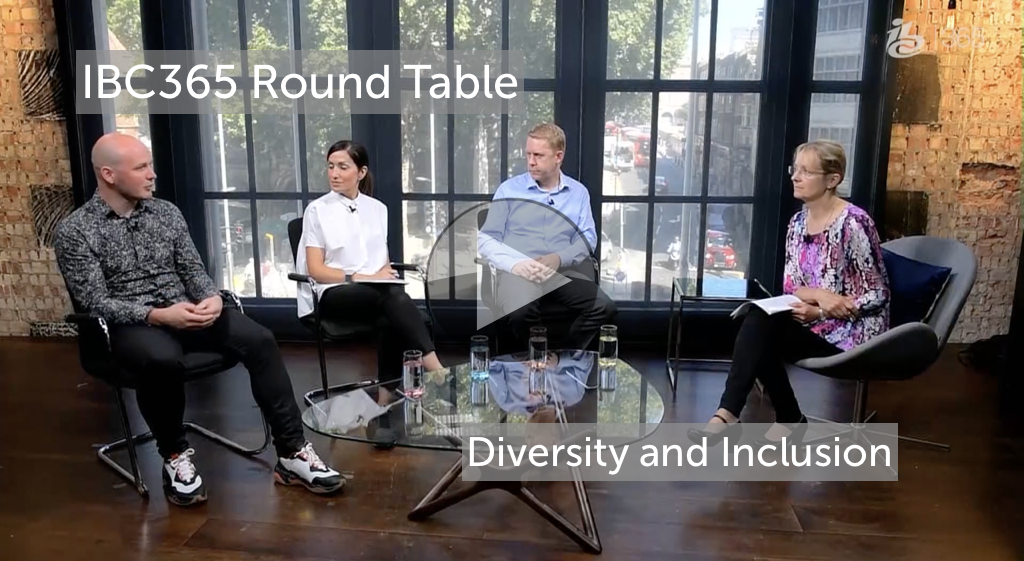
The IBC Roundtable discussion is back and this time tackles Diversity and Inclusion with views from Sundog Media Toolkit, ITV and Grass Valley, a Belden Company.
Topics include:
- Bringing diversity and inclusion into the company at large
- Benefits of diversity to the company
- Recruiting for diversity as a startup
- Supporting parents at work
- Altering the age balance in an organisation
- Working at the industry level to support company’s ability to hire
- Recruiting from outside the industry
- Role models & Mentoring
- How the industry is perceived through trade shows
Moderated by: Naomi Climer Chair, IBC Council
Speakers:
Neil Maycock VP Global Marketing, Grass Valley, a Belden Company
Faz Aftab Online Commerical Editor, ITV
Richard Welsh Co-founder and CEO, Sundog Media Toolkit
Video: DOCSIS 3.1 – An In-depth Overview
An in-depth talk explaining DOCSIS 3.1 from SCTE by Cisco’s Ron Hranac. DOCSIS 3.1 is the latest Data-Over-Cable Service Interface Specifications.
The presentation will include information on the following:
– Why DOCSIS 3.1?
– Basic principles of Orthogonal Frequency Division Multiplexing (OFDM).
– Spectrum allocation.
– FEC performance enhancements.
– New Proactive Network Maintenance (PNM) measurements.
CableLabs released version I01 of the new specification in late October 2013. DOCSIS 3.1 introduces a new physical layer, improved Forward Error Correction (FEC) and other features for high-speed data transmission on cable networks. Scalable to 10+ Gbps in the downstream and 1+ Gbps in the upstream, DOCSIS 3.1 supports services competitive with fibre to the home, but using cable’s HFC platform. Cisco’s Ron Hranac provides an overview of DOCSIS 3.1 from a physical layer perspective.
Video: The Fandom of the Opera

A lecture by Mark Schubin on how a 400-year-old art form helped create modern media technology.
Believe it or not, electronic home entertainment was invented for opera audiences. So were consumer headphones, movies, newscasts, and pay-cable. The first sportscasts were in opera houses.
The first wireless broadcast? The first commercial digital recording? The first live subtitles? All opera.
The idea of transmitting opera motion pictures and sounds live to theaters worldwide appeared in print in 1877, to homes in 1882. Without opera, there might not be communications satellites. And, according to pioneering radiologist Percy Brown, “No opera, no X-rays!” The first opera recordings were made 17 years before Edison’s first phonograph, and 76 years before that an automaton played opera music for Marie Antoinette. In the 21st century, labs around the world are working on ultra-high-speed communications systems for opera and have discussed neutrino communications and quantum entanglement. Galileo, Kepler, Lavoisier, Matisse – all had opera-technology connections. Stereo sound? The laryngoscope? Broadcast rights? All for opera. Really. Watch and be amazed.