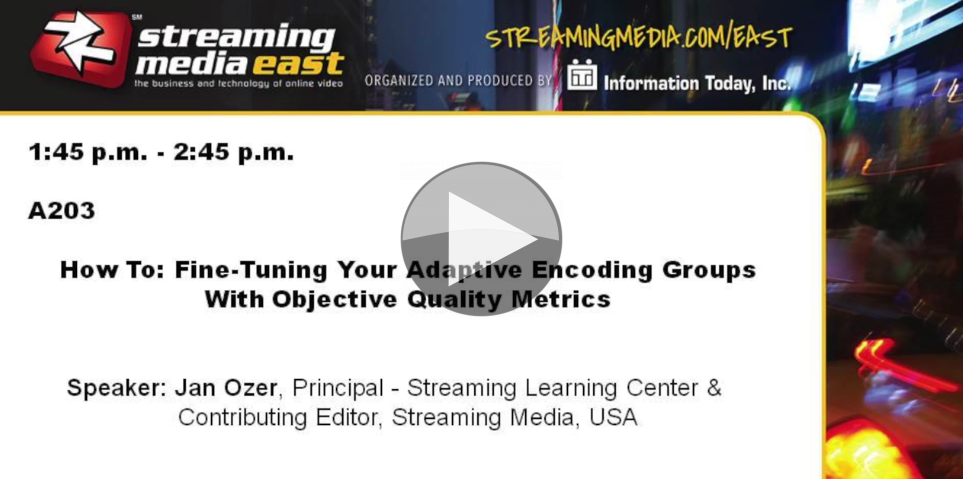
Video: How to Fine Tune your Adaptive Encoding Groups with Objective Quality Metrics


In this on-demaind video, Streaming Learning Center’s Jan Ozer explains objective metrics to us and how they can be used to build better ABR ladders.

Choosing the number of streams in an adaptive group and configuring them is usually a subjective, touchy-feely exercise, with no way to really gauge the effectiveness and efficiency of the streams. However, by measuring stream quality via metrics such as PSNR, SSIMplus, and VQM, you can precisely assess the quality delivered by each stream and its relevancy to the adaptive group.

This presentation identifies several key objective quality metrics, teaches how to apply them, and provides an objective framework for analyzing which streams are absolutely required in your adaptive group and their optimal configuration.

Watch now!

Webinar: Foundational Concepts: Video Compression, Processing and Delivery


On demand webinar from AWS Elemental covering some streaming basics.

In this webcast, you will:
• Learn how to create and deliver video over the internet
• Understand video codecs, containers, popular delivery methods and content delivery networks
• Consider methods, including adaptive bitrate streaming, that enable high-quality video to be delivered to a wide range of internet-connected devices
• Learn about the latest trends in video compression and delivery

Increasing smartphone subscriptions and data volumes per subscription are driving rapid growth in mobile data traffic, much of which is video content. According to multiple industry reports, these trends will continue for the near future, and by 2020, 75 percent of the world’s mobile data traffic will be video according to the Cisco Visual Networking Index. Technical and business leaders at organizations that aim to expand offerings using video need to understand the complexities of delivering premium viewing experiences to consumers.

Watch now!

Meeting: How Technology is Changing the Human Voice


Date: May 30th, 18:30 BST
Professor Trevor Cox presents a talk on the changing human voice. The human voice has always been in flux, but over the last hundred years or so, changes have been accelerated by technology. Watch a video of Barcelona, a duet between rock frontman Freddie Mercury and opera soprano Montserrat Caballé, and the difference between an old and new singing style is stark. These differences are not just about taste, they are driven by technology, with amplification freeing pop singers from the athletic task of reaching the back of a venue unaided. This allows someone like Freddie to be much more individualistic.
Actors’ voices have also changed, no longer do we have actor’s projecting their plumy voice using Received Pronunciation. But now viewers complain that they can’t understand the naturalistic accents used in modern TV and film. The talk will begin with examples likes these to explore the changing voice. It will then speculate about the future of the voice. What technologies might be developed to combat the loss of intelligibility caused by mumbling actors? As conversations with computers get more common, how might that change how we speak? Some have already found that Siri is a useful tool to get children to improve their diction. ‘Photoshop for voice’ has already been demonstrated. On the surface this is a useful tool for audio editors, but it also allows unscrupulous individuals to fake speech. Rich in sound examples, the talk will draw on Trevor’s latest popular science book, Now You’re Talking (Bodley Head 2018).

Register now!

Webinar: DRM – Back to Basics


Webinar: 15:00 & 20:00 BST 24th May 2018

Watching this webinar, you will learn about selecting and implementing the right premium content protection/DRM.

Content protection is key to a successful content monetisation strategy and with the recent evolution of streaming formats and standards, it is now easier than ever to create DRM-protected streaming systems. The ability to support all of today’s DRMs – including Widevine, Fairplay and PlayReady – in an efficient and easy-to-manage workflow is crucial for operators who want to enable richer feature sets, such as offline viewing and TVE.

Join Irdeto and Bitmovin for a live webinar to explore
+ Common approaches for Digital Rights Management in 2018
+ Changes coming to common workflows with CMAF (click here for primer on CMAF)
+ Real-world implementations of simple and complex systems

Register for the live webinar!

DATE & TIME:
2 sessions on Thursday, May 24

  • first at 4pm Central EU / 10am Eastern / 7am Pacific
  • second at 8pm Central EU / 2pm Eastern / 11am Pacific