Video: AES67 Beyond the LAN

It can be tempting to treat a good quality WAN connection like a LAN. But even if it has a low ping time and doesn’t drop packets, when it comes to professional audio like AES67, you can help but unconver the differences. AES67 was designed for tranmission over short distances meaning extremely low latency and low jitter. However, there are ways to deal with this.

Nicolas Sturmel from Merging Technologies is working as part of the AES SC-02-12M working group which has been defining the best ways of working to enable easy use of AES67 on the WAN wince the summer. The aims of the group are to define what you should expect to work with AES67, how you can improve your network connection and give guidance to manufacturers on further features needed.

WANs come in a number of flavours, a fully controlled WAN like many larger broadacsters have which is fully controlled by them. Other WANs are operated on SLA by third parties which can provide less control but may present a reduced operating cost. The lowest cost is the internet.

He starts by outlining the fact that AES67 was written to expect short links on a private network that you can completely control which causes problems when using the WAN/internet with long-distance links on which your bandwidth or choice of protocols can be limited. If you’re contributing into the cloud, then you have an extra layer of complication on top of the WAN. Virtualised computers can offer another place where jitter and uncertain timing can enter.

Link

The good news is that you may not need to use AES67 over the WAN. If you need precise timing (for lip-sync for example) with PCM quality and low latencies from 250ms down to as a little as 5 milliseconds do you really need AES67 instead of using other protocols such as ACIP, he explains. The problem being that any ping on the internet, even to something fairly close, can easily have a varying round trip time of, say, 16 to 40ms. This means you’re guaranteed 8ms of delay, but any one packet could be as late as 20ms. This variation in timing is known as the Packet Delay Variation (PDV).

Not only do we need to find a way to transmit AES67, but also PTP. The Precise Time Protocol has ways of coping for jitter and delay, but these don’t work well on WAN links whether the delay in one direction may be different to the delay for a packet in the other direction. PTP also isn’t built to deal with the higher delay and jitter involved. PTP over WAN can be done and is a way to deliver a service but using a GPS receiver at each location is a much better solution only hampered by cost and one’s ability to see enough of the sky.

The internet can lose packets. Given a few hours, the internet will nearly always lose packets. To get around this problem, Nicolas looks at using FEC whereby you are constantly sending redundant data. FEC can send up to around 25% extra data so that if any is lost, the extra information sent can be leveraged to determine the lost values and reconstruct the stream. Whilst this is a solid approach, computing the FEC adds delay and the extra data being constantly sent adds a fixed uplift on your bandwidth need. For circuits that have very few issues, this can seem wasteful but having a fixed percentage can also be advantageous for circuits where a predictable bitrate is much more important. Nicolas also highlights that RIST, SRT or ST 2022-7 are other methods that can also work well. He talks about these longer in his talk with Andreas Hildrebrand

Nocals finishes by summarising that your solution will need to be sent over unicast IP, possibly in a tunnel, each end locked to a GNSS, high buffers to cope with jitter and, perhaps most importantly, the output of a workflow analysis to find out which tools you need to deploy to meet your actual needs.

Watch now!
Speaker

Nicolas Sturmel Nicolas Sturmel
Network Specialist,
Merging Technologies

Video: What is IPMX? – The IPMX Stack

“The AV over IP market has really matured [giving us] great quality, low latency and the kind of stability and features that customers are looking for,” says Andrew Starks from Macnica Technology. If that’s the case, why do we need another standard by the name of IPMX? Intended to open up the AV-over-IP market and provide customers with a better deal, Andrew takes us through the motivations of AIMS, AMWA, VSF, SMPTE and the other organisations involved.

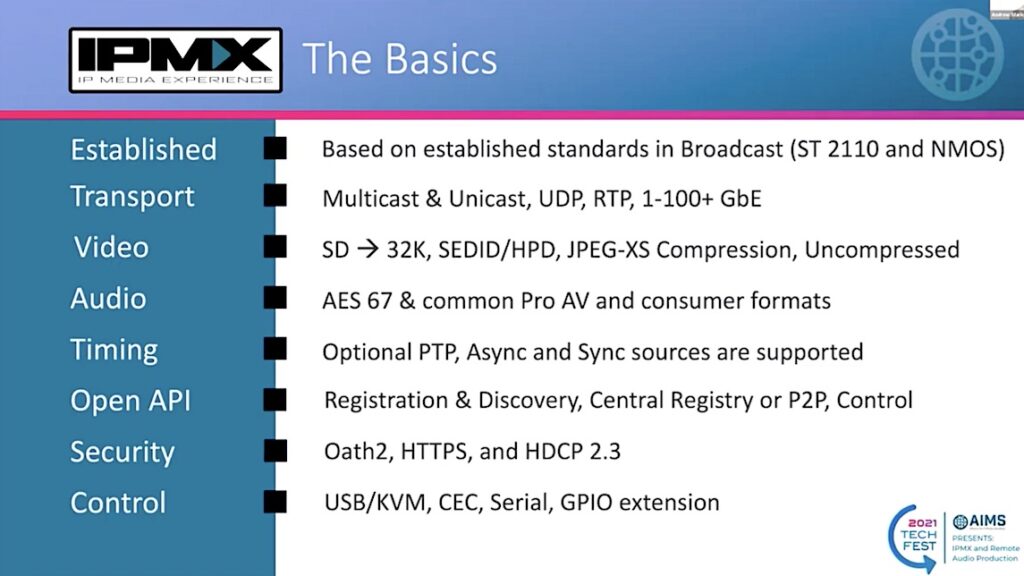
IPMX is a set of open standards and specifications which seek to bring a technology platform to the Pro AV industry on which all vendors can interoperate and innovate. Built on SMPTE’s ST 2110 suite of standards and the accompanying NMOS APIs from AMWA, IPMX adds essential capabilities such as HDMI, HDCP and USB support to create a complete and reliable foundation for AV events and installations.


Whilst there are a number of successful AV initiatives such as SDVoE, these are typically alliances built around a single-vendor hardware solution which is available to vendors in the alliance. This provides interoperability within that ecosystem but, explains Andrew, it prevents wider interoperability between vendors of different alliances. It also makes it hard to any vendor to innovate in the core feature set since that’s delivered from the single source relegating innovation to ‘plumbing’. For the vendors, at best, this means they have to contend with multiple, incompatible product lines and complicated support. Overall this results in a bad end user experience as they operate multiple islands which can have conflicting network requirements, i.e. 10GbE vs 1GbE.

IPMX can be implemented in software as well as hardware using compressed or uncompressed video with a focus on fully featured discovery as this has been identified as being as important as the ability to carry video. Timing has been made flexible such that it can operate with or without PTP which is one of a number of ways that it’s anticipated IPMX will be able to merge in with ST 2110 infrastructures.

Andrew finishes off his talk with a look at the tech stack of IPMX with layer 2 options from 1 to 100GbE connections supported on which RTP and PTP run. SMPTE’s ST 2110 standards feature heavily alongside a new standard for HDCP in 2110, a VSF spec for FEC and new specifications from AMWA for asynchronous control traffic like EDID, Serial, CEC, USB etc. Finally, there are the main APIs such as IS-04, -05 etc. as well as the application layer which uses OAuth2 for authenticating and has an RDS server for discovery. Lastly, there is a look at the JT-NM roadmap to see how the IPMX work will continue to advance throughout this year.

Watch now!
Speakers

Andrew Starks Andrew Starks
Director of Product Management,
Macnica America’s Inc.

Video: ST 2110 The Future of Live Remote Production

Trying to apply the SMPTE ST 2110 hype to the reality of your equipment? This video is here to help. There are many ‘benefits’ of IP which are banded about yet it’s almost impossible to realise them all in one company. For the early adopters, there’s usually one benefit that has been the deal-breaker with other benefits helping boost confidence. Smaller broadcast companies, however, can struggle to get the scale needed for cost savings, don’t require as much flexibility and can’t justify the scalability. But as switches get cheaper and ST 2110 support continues to mature, it’s clear that we’re beyond the early adopter phase.

This panel gives context to ST 2110 and advises on ways to ‘get started’ and skill up. Moderated by Ken Kerschbaumer from the Sports Video Group, Leader’s Steve Holmes, Prinyar Boon from Phabrix join the panel with Arista colleagues Gerard Phillips and Robert Welch and Bridge Technologies’ Chairman Simen Frostad.

The panel quickly starts giving advice. Under the mantra ‘no packet left behind’, Gerard explains that, to him, COTS (Commercial Off The Shelf) means a move to enterprise-grade switches ‘if you want to sleep at night’. Compared to SDI, the move to IT can bring cost savings but don’t skimp on your switch infrastructure if you want a good quality product. Simen was pleased to welcome 2110 as he appreciated the almost instant transmission that analogue gave. The move to digital added a lot of latency, even in the SDI portions of the chain thanks to frame syncs. ST 2110, he says, allows us to get back, most of the way, to no-latency production. He’s also pleased to bid good-bye to embedded data.

It is possible to start small, is the reassuring message next from the panel. The trick here is to start with an island of 2110 and do your learning there. Prinyar lifts up a tote bag saying he has a 2110 system he can fit in there which takes just 10 minutes to get up and running. With two switches, a couple of PTP grandmasters and some 2110 sources, you have what you need to start a small system. There is free software that can help you learn about it, Easy NMOS is a quick-to-deploy NMOS repository that will give you the basics to get your system up and running. You can test NMOS APIs for free with AMWA’s testing tool. The EBU’s LIST project is a suite of software tools that help to inspect, measure and visualize the state of IP-based networks and the high-bitrate media traffic they carry and there’s is also SDPoker which lets you test ST 2110 SDP files. So whilst there are some upfront costs, to get the learning, experience and understanding you need to make decisions on your ST 2110 trajectory, it’s cost-effective and can form part of your staging/test system should you decide to proceed with a project.

The key here is to find your island project. For larger broadcasters or OB companies, a great island is to build an IP OB truck. IP has some big benefits for OB Trucks as we heard in this webinar, such as weight reduction, integration with remote production workflows and scalability to ‘any size’ of event. Few other ‘islands’ are able to benefit in so many ways, but a new self-op studio or small control room may be just the project for learning how to design, install, troubleshoot and maintain a 2110 system. Prinyar cautions that 2110 shouldn’t be just about moving an SDI workflow into IP. The justification should be about improving workflows.

Remote control is big motivator for the move to ST 2110. Far before the pandemic, Discovery chose 2110 for their Eurosport production infrastructure allowing them to centralise into two European locations all equipment controlled in production centres in countries around Europe. During the pandemic, we’ve seen the ability to create new connections without having to physically install new SDI is incredibly useful. Off the back of remote control of resources, some companies are finding they are able to use operators from locations where the hourly rate is low.

Before a Q&A, the panel addresses training. From one quarter we hear that ensuring your home networking knowledge is sound (DHCP, basic IP address details) is a great start and that you can get across the knowledge needed very little time. Prinyar says that he took advantage of a SMPTE Virtual Classroom course teaching the CCNA, whilst Robert from Arista says that there’s a lot in the CCNA that’s not very relevant. The Q&A covers 2110 over WAN, security, hardware life cycles and the reducing carbon footprint of production.

Watch now!
Speakers

Steve Holmes Steve Holmes
Applications Engineer,
Leader
Prinyar Boon Prinyar Boon
Product Manager,
PHABRIX
Gerard Phillips Gerard Phillips
Systems Engineer,
Arista
Simen Frostad Simen Frostad
Chairman,
Bridge Technologies
Robert Welch Robert Welch
Technical Solutions Lead,
Arista
Ken Kerschbaumer Moderator: Ken Kerschbaumer
Chair & Editorial Directo,
Sports Video Group

Video: Time and timing at VidTrans21

Timing is both everything and nothing. Although much fuss is made of timing, often it’s not important. But when it is important, it can be absolutely critical. Helping us navigate through the broadcast chains varying dependence on a central co-ordinated time source is Nevion’s Andy Rayner in this talk at the VSF’s VidTrans21. When it comes down to it, you need time for coordination. In the 1840s, the UK introduced ‘Railway time’ bringing each station’s clock into line with GMT to coordinate people and trains.

For broadcast, working with multiple signals in a low-latency workflow is the time we’re most likely to need synchronisation such as in a vision or audio mixer. Andy shows us some of the original television technology where the camera had to be directly synchronised to the display. This is the era timing came from, built on by analogue video and RF transmission systems which had components whose timing relied on those earlier in the chain. Andy brings us into the digital world reminding us of the ever-useful blanking areas of the video raster which we packed with non-video data. Now, as many people move to SMPTE’s ST 2110 there is still a timing legacy as we see that some devices are still generating data with gaps where the blanking of the video would be even though 2110 has no blanking. This means we have to have timing modes for linear and non-linear delivery of video.


In ST 2110 every packet is marked with a reduced resolution timestamp from PTP, the Precision Time Protocol (or See all our PTP articles). This allows highly accurate alignment of essences when bringing them together as even a slight offset between audios can create comb filters and destroy the sound. The idea of the PTP timestamp is to stamp the time the source was acquired. But Andy laments that in ST 2110 it’s hard to keep this timestamp since interim functions (e.g. graphics generators) may restamp the PTP breaking the association.

Taking a step back, though, there are delays now up to a minute later delivering content to the home. Which underlines that relative timing is what’s most important. A lesson learnt many years back when VR/AR was first being used in studios where whole sections of the gallery were running several frames delayed to the rest of the facility to account for the processing delay. Today this is more common as is remote production which takes this fixed time offset to the next level. Andy highlights NMOS IS-07 which allows you timestamp button presses and other tally info allowing this type of time-offset working to succeed.

The talk finishes by talking about the work of the GCCG Activity Group at the VSF of which Andy is the co-chair. This group is looking at how to get essences into and out of the cloud. Andy spends some time talking about the tests done to date and the fact that PTP doesn’t exist in the cloud (it may be available for select customers). In fact you may have live with NTP-derived time. Dealing with this is still a lively discussion in progress and Andy is welcoming participants.

Watch now!
Speakers

Andy Rayner Andy Rayner
Co-Chair, Ground-Cloud-Cloud-Ground Activity Group, VSF
Chief Technologist, Nevion