Video: IPMX for Broadcast Installations?

IPMX, the new ProAV IP challenger spec, is taking shape promising to tame SMPTE’s ST 2110 standards, make PTP useable and extend AMWA into managing HDCP. Is this a tall order and can it actually deliver? Taking us through the ins and out is Jean Lapierre from Matrox.

With or without IPMX, ProAV is moving to IP whether with SDVoE, ZeeVee or something else. There are a number of competing technologies, but we hear from Jean that IPMX is the only software-defined one. This is important because if you don’t require a chip to be an IPMX product and participate in ProAV workflows, then anything can support IPMX such as PCs, Laptops and mobile phones.


IPMX based on RTP, ST 2110, ST 2059 PTP and AMWA specifications IS-04, IS-05, IS-08 (audio channel mapping), IS-11 for EDID handling as well as NMOS security and best practice guidance. This seems like a lot, but to cover media transfer, registration, control, security and interfacing with display screens, this is the range of tech needed.

Compared to SMPTE ST 2110, the PTP profile is easier to deploy and produces less traffic, explains Jean, and IPMX even works without PTP which support for asynchronous signals. Support of HDCO is included along with a lower-latency FEC mode for those that find 2022-7 too costly or impractical to deploy. Lastly, Jean points out that thanks to the in-built support for JPEG XS, IPMX can support UHD workflows within a 1GbE infrastructure.

Jean continues by discussing the compatibility between 2110 and IPMX. In principle IPMX and 2110 senders and receivers are interchangeable. Jean goes into more detail, but the example would be that IPMX is managing the HDCP encryption of the source using AMWA NMOS IS-11. IS-11 is, naturally available to be used with any other technology including ST 2110. If it’s adopted, then HDCP-protected material can flow between the two systems.

Watch now!
Speaker

Jean Lapierre Jean Lapierre
Senior Director, Advanced Technologies,
Matrox

Video: A Frank Discussion of NMOS

What NMOS isn’t is almost as important as what NMOS actually is when it comes to defining a new project implementing SMPTE ST 2110. Written by AMWA, NMOS is a suite of open specifications which help control media flow hence the name: Network Media Open Specifications. Typically NMOS specifications are used alongside the ST 2110 standards but in this hype-free panel, we hear that 2110 isn’t the only application of NMOS.

AMWA Executive Director Brad Gilmer introduces this ‘frank’ panel with Imagine’s John Mailhot explaining the two meanings ‘NMOS’ has. The first is the name of the project we have just introduced in this article. The second is as shorthand for the two best-known specifications created by the project, IS-04 and IS-05. Together, these allow new devices to register their availability to the rest of the system and to receive instructions regarding sending media streams. There are plenty of other specifications which are explained in this talk of which two more are mentioned later in this video: IS-08 which manages audio channel mapping and IS-09 which allows new devices to get a global configuration to automatically find out facts like their PTP domain.


Security is “important and missing previously,” says Jed Deame from Nextera but explains that since NMOS is predominantly a specification for HTTP API calls, there is nothing to stop this from happening as HTTPS or another protocol as long as it provides both encryption and authorisation. The panel then explores the limits of the scope of NMOS. For security, its scope is to secure the NMOS control traffic, so doesn’t stretch to securing the media transport or, say, PTP. Furthermore, for NMOS as a whole, it’s important to remember it defines control and not more than control. Brad says, though, that even this scope is ambiguous as where does the concept of ‘control’ stop? Is a business management system control? What about scheduling of media? Triggering playback? There have to be limited.

Imagine Communications’ John Mailhot explores the idea of control asking how much automation, and hence NMOS-style control, can help realise one of the promises of IP which is to reduces costs by speeding up system changes. Previously, Brad and John explain, changing a studio from doing NFL to doing NHL may take up to a month of rewiring and reprogramming. Now that rewiring can be done in software, John contends that the main task is to make sure the NMOS is fully-fledged enough to allow interoperable enumeration, configuration and programming of links within the system. The current specifications are being reinforced by ‘modelling’ work whereby the internal logical blocks of equipment, say an RGB gain control, can be advertised to the network as a whole rather than simply advertising a single ‘black box’ like an encoder. Now it’s possible to explain what pre and post-processing is available.

Another important topic explored by NVIDIA’s Richard Hastie and Jeremy Nightingale from Macnica, is the use of NMOS specifications outside of ST 2110 installations. Richard says that NVIDIA is using NMOS in over 200 different locations. He emphasises its use for media whether that be HEVC, AV1 or 2110. As such, he envisages it being used by ‘Twitch streamers’ no doubt with the help of the 2110-over-WAN work which is ongoing to find ways to expose NMOS information over public networks. Jeremy’s interest is in IPMX for ProAV where ‘plug and play’ as well as security are two of the main features being designed into the package.

Lastly, there’s a call out to the tools available. Since NMOS is an open specification project, the tools are released as Open Source which companies being encouraged to use the codebase in products or for testing. Not only is there a reference client, but Sony and BBC have released an NMOS testing tool and EasyNMOS provides a containerised implementation of IS-04 and IS-05 for extremely quick deployments of the toolset.

Watch now!
Speakers

Brad Gilmer Brad Gilmer
Executive Director, Video Services Forum
Executive Director, Advanced Media Workflow Association (AMWA)
John Mailhot John Mailhot
CTO Networking & Infrastructure
Jed Deame Jed Deame
CEO,
Nextera Video
Richard Hastie Richard Hastie
Senior Sales Director,
NVIDIA
Jeremy Nightingale
President
Macnica Americas, Inc.

Video: A Review of the IP Live Core Implementation in BBC Cymru Wales

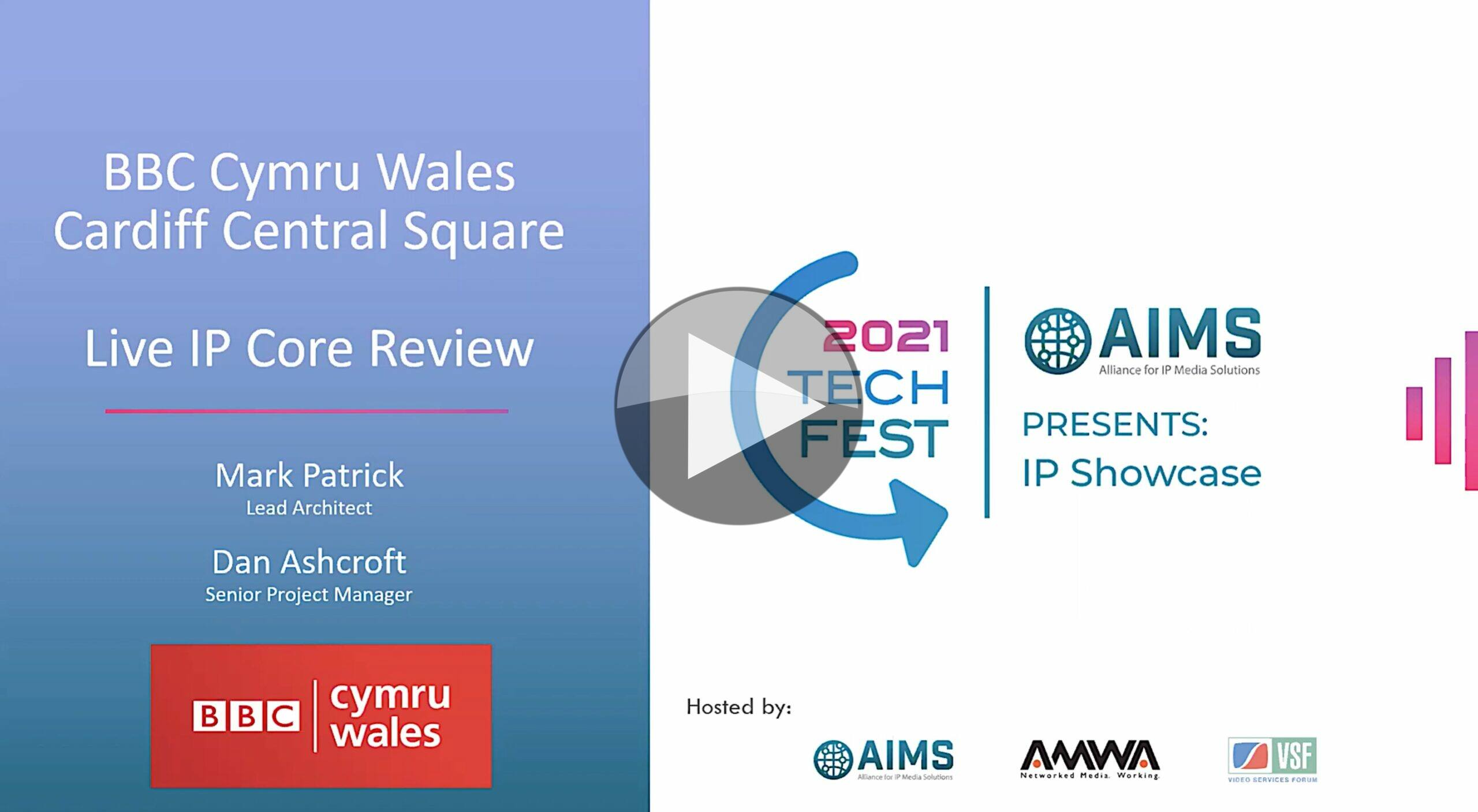
Whenever there’s a step change in technology, we need early adopters and moving to SMPTE’s ST 2110 is no exception. Not only do early adopters help show that the path ahead is good, but they often do a lot to beat down the bushes and make the path easier to pass for all that follow. For larger companies whose tech refresh or building move comes at a time when the industry is facing a major technology change, there comes a time when whilst the ground may not be firm ahead, the company can’t justify investing in technology that would soon be out of date or in technology which won’t support the needs of the company in several years’ time. This is just the situation that BBC Cymru Wales found themselves in when it was time to move out of their old property into a purpose-built national HQ in the heart of Cardiff.

In this video from the IP Showcase, Mark Patrick and Dan Ashcroft guide us through ‘whys’ and the ‘hows’ of the relocation project. It’s important to remember that this project was long in the making with the decision on location taking place in 2014 with the technology decisions taking place in 2016 and 2017. The project took an open approach to the IP/SDI question and asked for RFP responses to include a fully-SDI and a fully-IP option. It was clear during the selection process that IP was the way to go not because the solution was cheaper in the short term, but because it was much more future-proof and the costs would come down over time giving a much better total cost of ownership. Don’t forget that the initial costs of HD video equipment were much higher than those now. For more on the pros and cons of SDI, watch ‘Is IP really better than SDI?‘ by Ed Calverly.


Mark and Dan talk through the thinking for the IP choice and their decision to pick a vendor who would be their partner in the project. The theory being that given the standards were still very young, it would be important to work closely to ensure success. In addition to Grass Valley equipment, they chose a Cisco network with Cisco SDN control and operational control by BNCS. The talk references architectures we’ve featured on The Broadcast Knowledge before with Arista’s Gerard Phillips discussing the dual-network spine-leaf architecture chosen and noting the difficulty they had incorporating the Dante network into the 2110 infrastructure and their choice of a third network purely for control traffic.

We often hear about the importance of PTP in a SMPTE ST 2110 network for live production because it is vital to keep all the essences in sync. For more information about the basics of ST 2110 check out this talk by Wes Simpson. PTP is both simple and complex so Mark explains how they’ve approached distributing PTP ensuring that the separate networks, amber and blue, can share PTP grandmasters for resilience.

Other topics covered in the talk include

  • Control Methodology
  • AES67 and Dante
  • Testing equipment
  • JT-NM interoperability testing
  • Successes and difficulties

Watch now!
Speakers

Mark Patrick Mark Patrick
Lead Architect,
BBC
Dan Ashcroft Dan Ashcroft
Senior Project Manager,
BBC
Wes Simpson Moderator: Wes Simpson
LearnIPVideo.com

Video: AES67 Over Wide Area Networks


AES67 is a widely adopted standard for moving PCM audio from place to place. Being a standard, it’s ideal for connecting equipment together from different vendors and delivers almost zero latency, lossless audio from place to place. This video looks at use cases for moving AES from its traditional home on a company’s LAN to the WAN.

Discovery’s Eurosport Technology Transformation (ETT) project is a great example of the compelling use case for moving to operations over the WAN. Eurosport’s Olivier Chambin explains that the idea behind the project is to centralise all the processing technology needed for their productions spread across Europe feeding their 60 playout channels.

Control surfaces and some interface equipment is still necessary in the European production offices and commentary points throughout Europe, but the processing is done in two data centres, one in the Netherlands, the other in the UK. This means audio does need to travel between countries over Discovery’s dual MPLS WAN using IGMPv3 multicast with SSM

From a video perspective, the ETT project has adopted 2110 for all essences with NMOS control. Over the WAN, video is sent as JPEG XS but all audio links are 2022-7 2110-30 with well over 10,000 audio streams in total. Timing is done using PTP aware switches with local GNSS-derived PTP with a unicast-over-WAN as a fallback. For more on PTP over WAN have a look at this RTS webinar and this update from Meinberg’s Daniel Boldt.


Bolstering the push for standards such as AES67 is self-confessed ‘audioholic’ Anthony P. Kuzub from Canada’s CBC. Chair of the local AES section he makes the point that broadcast workflows have long used AES standards to ensure vendor interoperability from microphones to analogue connectors, from grounding to MADI (AES10). This is why AES67 is important as it will ensure that the next generation of equipment can also interoperate.

Surrounding these two case studies is a presentation from Nicolas Sturmel all about the AES SC-02-12-M working group which aims to define the best ways of working to enable easy use of AES67 on the WAN. The key issue here is that AES67 was written expecting short links on a private network that you can completely control. Moving to a WAN or the internet with long-distance links on which your bandwidth or choice of protocols is limited can make AES67 perform badly if you don’t follow the best practices.

To start with, Nicolas urges anyone to check they actually need AES67 over the WAN to start with. Only if you need precise timing (for lip-sync for example) with PCM quality and low latencies from 250ms down to as a little as 5 milliseconds do you really need AES67 instead of using other protocols such as ACIP, he explains. The problem being that any ping on the internet, even to something fairly close, can easily take 16 to 40ms for the round trip. This means you’re guaranteed 8ms of delay, but any one packet could be as late as 20ms known as the Packet Delay Variation (PDV).

Not only do we need to find a way to transmit AES67, but also PTP. The Precise Time Protocol has ways of coping for jitter and delay, but these don’t work well on WAN links whether the delay in one direction may be different to the delay for a packet in the other direction. PTP also isn’t built to deal with the higher delay and jitter involved. PTP over WAN can be done and is a way to deliver a service but using a GPS receiver at each location, as Eurosport does, is a much better solution only hampered by cost and one’s ability to see enough of the sky.

The internet can lose packets. Given a few hours, the internet will nearly always lose packets. To get around this problem, Nicolas looks at using FEC whereby you are constantly sending redundant data. FEC can send up to around 25% extra data so that if any is lost, the extra information sent can be leveraged to determine the lost values and reconstruct the stream. Whilst this is a solid approach, computing the FEC adds delay and the extra data being constantly sent adds a fixed uplift on your bandwidth need. For circuits that have very few issues, this can seem wasteful but having a fixed percentage can also be advantageous for circuits where a predictable bitrate is much more important. Nicolas also highlights that RIST, SRT or ST 2022-7 are other methods that can also work well. He talks about these longer in his talk with Andreas Hildrebrand

The video concludes with a Q&A.

Watch now!
Speakers

Nicolas Sturmel Nicolas Sturmel
Product Manager – Senior Technologist,
Merging Technologies
Anthony P. Kuzub Anthony P. Kuzub
Senior Systems Designer,
CBC/Radio Canada
Olivier Chambin Olivier Chambin
Audio Broadcast Engineer, AioP and Voice-over-IP
Eurosport Discovery