
Video: As Time Goes by…Precision Time Protocol in the Emerging Broadcast Networks

How much timing do you need? PTP can get you timing in the nanoseconds, but is that needed, how can you transport it and how does it work? These questions and more are under the microscope in this video from RTS Thames Valley.

SMPTE Standards Vice President, Bruce Devlin introduces the two main speakers by reminding us why we need timing and how we dealt with it in the past. Looking back to the genesis of television, points out Bruce, everything was analogue and it was almost impossible to delay a signal at all. An 8cm, tightly wound coil of copper would give you only 450 nanoseconds of delay alternatively quartz crystals could be used to create delays. In the analogue world, these delays were used to time signals and since little could be delayed, only small adjustments were necessary. Bruce’s point is that we’ve swapped around now. Delays are everywhere because IP signals need to be buffered at every interface. It’s easy to find buffers that you didn’t know about and even small ones really add up. Whereas analogue TV got us from camera to TV within microseconds, it’s now a struggle to get below two seconds.

Hand in hand with this change is the change from metadata and control data being embedded in the video signal – and hence synchronised with the video signal – to all data being sent separately. This is where PTP, Precision Time Protocol, comes in. An IP-based timing mechanism that can keep time despite the buffers and allow signals to be synchronised.


Next to speak is Richard Hoptroff whose company works with broadcasters and financial services to provide accurate time derived from 4 satellite services (GPS, GLONASS etc) and the Swedish time authority RiSE. They have been working on the problem of delivering time to people who can’t put up antennas either because they are operating in an AWS datacentre or broadcasting from an underground car park. Delivering time by a wired network, Richard points out, is much more practical as it’s not susceptible to jamming and spoofing, unlike GPS.

Richard outlines SMPTE’s ST 2059-2 standard which says that a local system should maintain accuracy to within 1 microsecond. the JT-NM TR1001-1 specification calls for a maximum of 100ms between facilities, however Richard points out that, in practice, 1ms or even 10 microseconds is highly desired. And in tests, he shows that with layer 2, PTP unicast looping around western Europe was able to adhere to 1 microsecond, layer 3 within 10 microseconds. Over the internet, with a VPN Richard says he’s seen around 40 microseconds which would then feed into a boundary clock at the receiving site.

Summing up Richard points out that delivering PTP over a wired network can deliver great timing without needing timing hardware on an OPEX budget. On top of that, you can use it to add resilience to any existing GPS timing.

Gerard Philips from Arista speaks next to explain some of the basics about how PTP works. If you are interested in digging deeper, please check out this talk on PTP from Arista’s Robert Welch.

Already in use by many industries including finance, power and telecoms, PTP is base on IEEE-1588 allowing synchronisation down to 10s of nanoseconds. Just sending out a timestamp to the network would be a problem because jitter is inherent in networks; it’s part and parcel of how switches work. Dealing with the timing variations as smaller packets wait for larger packets to get out of the way is part of the job of PTP.

To do this, the main clock – called the grandmaster – sends out the time to everyone 8 times a second. This means that all the devices on the network, known as endpoints, will know what time it was when the message was sent. They still won’t know the actual time because they don’t know how long the message took to get to them. To determine this, each endpoint has to send a message back to the grandmaster. This is called a delay request. All that happens here is that the grandmaster replies with the time it received the message.
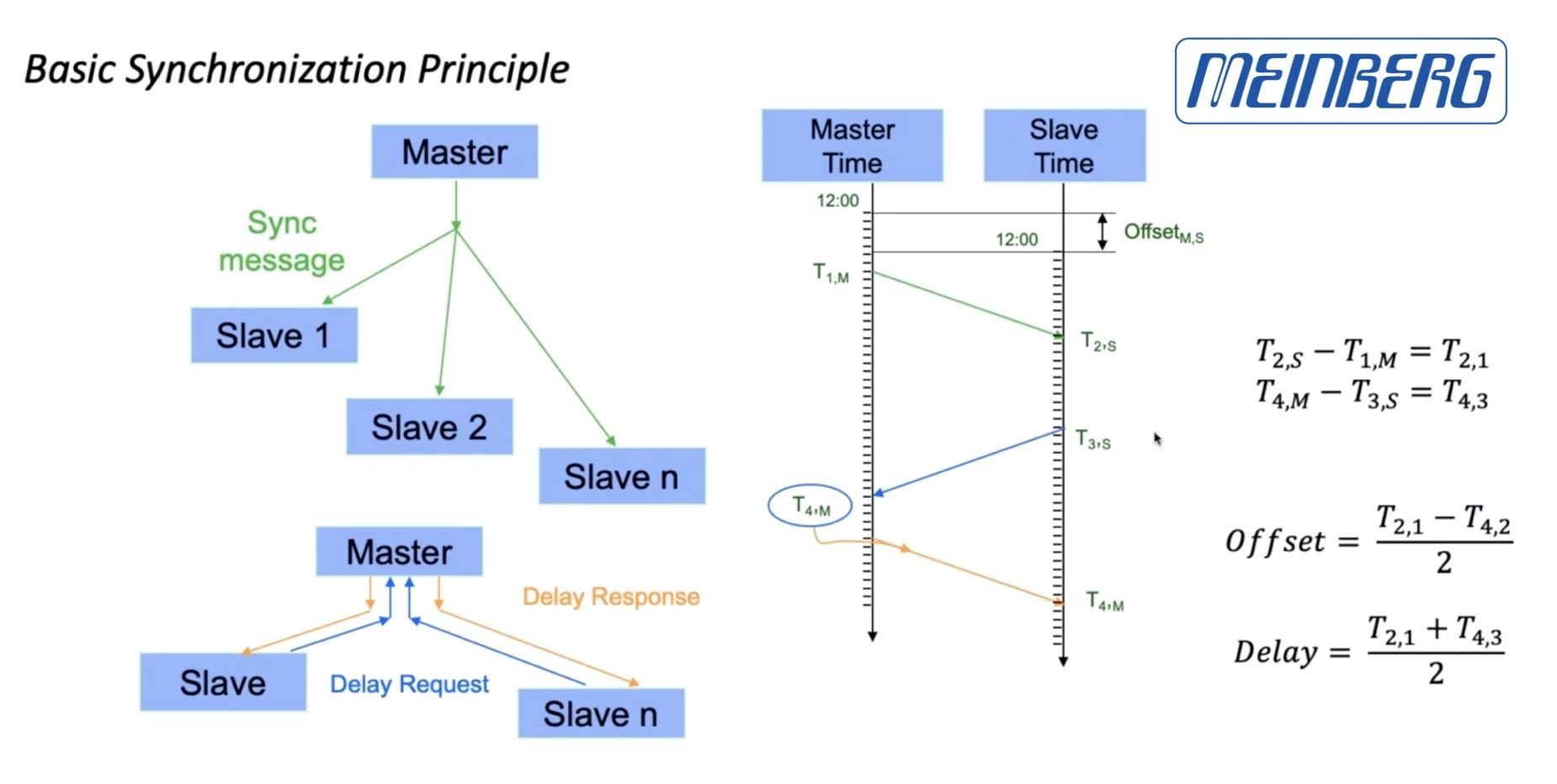
PTP Primary-Secondary Message Exchange.
Source: Meinberg [link]

This gives us 4 points in time. The first (t1) is when the grandmaster sent out the first message. The second (t2) is when the device received it. t3 is when the endpoint sent out its delay request and t4 is the time when the master clock received that request. The difference between t2 and t1 indicates how long the original message took to get there. Similarly, t4-t3 gives that information in the other direction. These can be combined to derive the time. For more info either check out Arista’s talk on the topic or this talk from RAVENNA and Meinberg from which the figure above comes.

Gerard briefly gives an overview of Boundary Clock which act as secondary time sources taking pressure off the main grandmaster(s) so they don’t have to deal with thousands of delay requests, but they also solve a problem with jitter of signals being passed through switches as it’s usually the switch itself which is the boundary clock. Alternatively, Transparent Clock switches simply pass on the PTP messages but they update the timestamps to take account of how long the message took to travel through the switch. Gerard recommends only using one type in a single system.

Referring back to Bruce’s opening, Gerard highlights the need to monitor the PTP system. Black and burst timing didn’t need monitoring. As long as the main clock was happy, the DA’s downstream just did their job and on occasion needed replacing. PTP is a system with bidirectional communication and it changes depending on network conditions. Gerard makes a plea to build a monitoring system as part of your solution to provide visibility into how it’s working because as soon as there’s a problem with PTP, there could quickly be major problems. Network switches themselves can provide a lot of telemetry on this showing you delay values and allowing you to see grandmaster changes.

Gerard’s ‘Lessons Learnt’ list features locking down PTP so only a few ports are actually allowed to provide time information to the network, dealing carefully with audio protocols like Dante which need PTP version 1 domains, and making sure all switches are PTP-aware.

The video finishes with Q&A after a quick summary of SMPTE RP 2059-15 which is aiming to standardise telemetry reporting on PTP and associated information. Questions from the audience include asking how easy it is to do inter-continental PTP, whether the internet is prone to asymmetrical paths and how to deal with PTP in the cloud.

Watch now!
Speakers

Bruce Devlin Bruce Devlin
Standards Vice President,
SMPTE
Gerard Phillips Gerard Phillips
Systems Engineer,
Arista
Richard Hoptroff Richard Hoptroff
Founder and CTO
Hoptroff London Ltd

Video: IPMX – Debunking the Myths

2110 for AV? IPMX is an IP specification for interoperating Pro AV equipment. SMPTE’s 2110 standard suite is very powerful, but not deployable easily enough to rig for a live event. At the moment the is no open standard in Pro AV that can deliver IP. Whilst there are a number of proprietary alliances, which enable widespread use of a single chip or software core, this interoperability comes at a cost and ultimately is underpinned by one, or a group of companies.

Dave Chiappini from Matrox discusses the work of the AIMS Pro AV working group which is developing IPMX. Dave underlines the fact that this is a pull to unify the Pro AV industry to help people avoid investing over and over again in reinventing protocols or reworking their products to interoperate. He feels that ‘open standards help propel markets forward’ adding energy and avoiding vendor lock-in. This is one reason for the inclusion of NMOS, allowing any vendor to make a control system by working to the same open specification, opening up the market to both small and large companies.

The Pro AV market needs more than just swift deployment. HDMI is pervasive and is able to carry more frame rates and resolutions than SDI so HDMI support is to of the list of features that IPMX will add on top of 2110, NMOS and PTP. HDMI also uses HDCP so AIMS is now working with the DCP on creating a method of carrying HDCP over 2110. TVs are already replacing SDI monitors, such interoperability with HDMI should bring down the costs of monitoring for non-picture critical environments.

Timing can be pricey and complex if PTP and GPS are required. A lot of time and effort goes into making the PTP infrastructure work properly within SMPTE 2110 infrastructure. Having to do this at an event whilst setting up in a short timespan is not helpful to anyone and, elaborates Dave, a point to point video link simply doesn’t need high precision timing. Not only does IPMX relax the timing requirements, but it will also support asynchronous video streams.

David explains that whilst there are times when zero compression is needed in both AV and Broadcast, a lot of the time we need video that will easily fit into 1Gbps. For this, JPEG XS is being used which is a lightweight codec that can be run in software, FPGA and more. This supports 4:4:4 video for maximum fidelity. For more about JPEG XS, have a listen to this talk. Some good news for bandwidth fans is that all new Intel chips support 2.5Gbe networking using existing cabling which IMPX will be supporting.

Pro AV needs the ability to throw some preview video out to an iPad or similar. This isn’t going to work with JPEG XS, the preferred ‘minimal compression’ codec for IPMX, so a system for including H264 or H265 is being investigated which could have knock-on benefits for Broadcast.

David finishes by underlining that IMPX will be an open standard that can be implemented in software on a server, on a desktop or on a mobile phone. It’s scalable and ready to support the ProAV and events industry.

Watch now!
Speakers

David Chiappini David Chiappini
Chair, Pro AV Working Group, AIMS
Executive Vice President, Research & Development,
Matrox Graphics Inc.

Video: The Fundamentals of Virtualisation

Virtualisation is continuing to be a driving factor in the modernisation of broadcast workflows both from the technical perspective of freeing functionality from bespoke hardware and from the commercial perspective of maximising ROI by increasing utilisation of infrastructure. Virtualisation itself is not new, but using it in broadcast is still new to many and the technology continues to advance to deal with modern bitrate and computation requirements.

In these two videos, Tyler Kern speaks to Mellanox’s Richard Hastie, NVIDIA’s Jeremy Krinitt and John Naylor from Ross Video explain how virtualisation fits with SMPTE ST 2110 and real-time video workflows.

Richard Hastie explains that the agility is the name of the game by separating the software from hardware. Suddenly your workflow, in principle can be deployed anywhere and has the freedom to move within the same infrastructure. This opens up the move to the cloud or to centralised hosting with people working remotely. One of the benefits of doing this is the ability to have a pile of servers and continually repurpose them throughout the day. Rather than have discrete boxes which only do a few tasks, often going unused, you can now have a quota of compute which is much more efficiently used so the return on investment is higher as is the overall value to the company. As an example, this principle is at the heart of Discovery’s transition of Eurosport to ST 2110 and JPEG XS. They have centralised all equipment allowing for the many countries around Europe which have production facilities to produce remotely from one, heavily utilised, set of equipment.

Part I

John Naylor explains the recent advancements brought to the broadcast market in virtualisation. vMotion from VMware allows live-migration of virtual. machines without loss of performance. When you’re running real-time graphics, this is really important. GPU’s are also vital for graphics and video tasks. In the past, it’s been difficult for VMs to have full access to GPUs, but now not only is that practical but work’s happened to allow a GPU to be broken up and these reserved partitions dedicated to a VM using NVIDIA Ampere architecture.
John continues by saying that VMWare have recently focussed on the media space to allow better tuning for the hypervisor. When looking to deploy VM infrastructures, John recommends that end-users work closely with their partners to tune not only the hypervisor but the OS, NIC firmware and the BIOS itself to deliver the performance needed.

“Timing is the number one challenge to the use of virtualisation in broadcast production at the moment”

Richard Hastie

Mellanox, now part of NVIDIA, has continued improving its ConnectX network cards, according to Richard Hastie, to deal with the high-bandwidth scenarios that uncompressed production throws up. These network cards now have onboard support for ST 2110, traffic shaping and PTP. Without hardware PTP, getting 500-nanosecond-accurate timing into a VM is difficult. Mellanox also use SR-IOV, a technology which bypasses the software switch in the hypervisor, reducing I/O overhead and bringing performance close to non-virtualised performance. It does this by partitioning the PCI bus meaning one NIC can present itself multiple times to the computer and whilst the NIC is shared, the software has direct access to it. For more information on SR-IOV, have a look at this article and this summary from Microsoft.

Part II

Looking to the future, the panel sees virtualisation supporting the deployment of uncompressed ST 2110 and JPEG XS workflows enabling a growing number of virtual productions. And, for virtualisation itself, a move down from OS-level virtualisation to containerised microservices. Not only can these be more efficient but, if managed by an orchestration layer, allow for processing to move to the ‘edge’. This should allow some logic to happen. much closer to the end-user at the same time as allowing the main computation to be centralised.

Watch part I and part II now!
Speakers

Tyler Kern Tyler Kern
Moderator
John Naylor John Naylor
Technology Strategist & Director of Product Security
Ross
Richard Hastie Richard Hastie
Senior Sales Director, Business Development
NVIDIA
Jeremy Krinitt Jeremy Krinitt
Senior Developer Relations Manager
NVIDIA

Video: AES67/ST 2110-30 over WAN

Dealing with professional audio, it’s difficult to escape AES67 particularly as it’s embedded within the SMPTE ST 2110-30 standard. Now, with remote workflows prevalent, moving AES67 over the internet/WAN is needed more and more. This talk brings the good news that it’s certainly possible, but not without some challenges.

Speaking at the SMPTE technical conference, Nicolas Sturmel from Merging Technologies outlines the work being done within the AES SC-02-12M working group to define the best ways of working to enable easy use of AES67 on the WAn. He starts by outlining the fact that AES67 was written to expect short links on a private network that you can completely control which causes problems when using the WAN/internet with long-distance links on which your bandwidth or choice of protocols can be limited.

To start with, Nicolas urges anyone to check they actually need AES67 over the WAN to start with. Only if you need precise timing (for lip-sync for example) with PCM quality and low latencies from 250ms down to as a little as 5 milliseconds do you really need AES67 instead of using other protocols such as ACIP, he explains. The problem being that any ping on the internet, even to something fairly close, can easily take 16 to 40ms for the round trip. This means you’re guaranteed 8ms of delay, but any one packet could be as late as 20ms known as the Packet Delay Variation (PDV).

Link

Not only do we need to find a way to transmit AES67, but also PTP. The Precise Time Protocol has ways of coping for jitter and delay, but these don’t work well on WAN links whether the delay in one direction may be different to the delay for a packet in the other direction. PTP also isn’t built to deal with the higher delay and jitter involved. PTP over WAN can be done and is a way to deliver a service but using a GPS receiver at each location is a much better solution only hampered by cost and one’s ability to see enough of the sky.

The internet can lose packets. Given a few hours, the internet will nearly always lose packets. To get around this problem, Nicolas looks at using FEC whereby you are constantly sending redundant data. FEC can send up to around 25% extra data so that if any is lost, the extra information sent can be leveraged to determine the lost values and reconstruct the stream. Whilst this is a solid approach, computing the FEC adds delay and the extra data being constantly sent adds a fixed uplift on your bandwidth need. For circuits that have very few issues, this can seem wasteful but having a fixed percentage can also be advantageous for circuits where a predictable bitrate is much more important. Nicolas also highlights that RIST, SRT or ST 2022-7 are other methods that can also work well. He talks about these longer in his talk with Andreas Hildrebrand

Watch now!
Speaker

Nicolas Sturmel Nicolas Sturmel
Product Manager, Senior Technologist,
Merging Technologies