Video: ST-2110 – Measuring and Testing the Data, Control and Timing Planes

An informal chat touching on the newest work around SMPTE ST-2110 standards and related specifications in today’s video. The industry’s leading projects are now tracking the best practices in IT as much as the latest technology in IP because simply getting video working over the network isn’t enough. Broadcasters demand solutions which are secure from the ground up, easy to deploy and have nuanced options for deployment.

Andy Rayner from Nevion talks to Prin Boon from Phabrix to understand the latest trends. Between then, Andy and Prin account for a lot of activity in standards work within standards and industry bodies such as SMPTE, VSF and JT-NM to name a but a few, so whom better to hear from regarding the latest thinking and ongoing work.

Andy starts by outlining the context of SMPTE’s ST-2110 suite of standards which covers not only the standards within 2110, but also the NMOS specifications from AMWA as well as the timing standards (SMPTE 2059 and IEEE 1588). Prin and Andy both agree that the initial benefit of moving to IT networking was benefiting from the massive network switches which now delivering much higher switching density than SDI ever could or would, now the work of 2110 projects is also tracking IT, rather than simply IP. By benefiting from the best practices of the IT industry as a whole, the broadcast industry is getting a much better product. Andy makes the point that broadcast-uses have very much pushed fabric manufacturers to implement PTP and other network technologies in a much more mature and scalable way than was imagined before.

Link to video

The focus of conversation now moves to the data, control and timing plane. The data plane contains the media essences and all of the ST 21110 standards. Control is about the AMWA/NMOS specs such as the IS-0X specs as well as the security-focused BCP-003 and JT-NM TR-1001. Timing is about PTP and associated guidelines.

Prin explains that in-service test and measurement is there to give a feeling for the health of a system; how close to the edge is the system? This is about early alerting of engineering specialists and then enable deep faultfinding with hand-held 2110 analysers. Phabrix, owned by Leader, are one of a number of companies who are creating monitoring and measurement tools. In doing this Willem Vermost observed that little of the vendor data was aligned so couldn’t be compared. This has directly led to work between many vendors and broadcasters to standardise the reported measurement data in terms of how it’s measured and how it is named and is being standardised under 2110-25. This will cover latency, video timing, margin and RTP offset.

More new work discussed by the duo includes the recommended practice, RP 2059-15 which is related to the the ST 2059 standards which apply PTP to media streams. As PTP, also known as IEEE 1588 has been updated to version 2.1 as part of the 2019 update, this RP creates a unified framework to expose PTP data in a structured manner and relies on RFC 8575 which, itself, relies on the YANG data modeling language.

We also hear about work to ensure that NMOS can fully deal with SMPTE 2022-7 flows in all the cases where a receiver is expecting a single or dual feed. IS-08 corner cases have been addressed and an all-encompassing model to develop against has been created as a reference.

Pleasingly, as this video was released in December, we are treated to a live performance of a festive song on piano and trombone. Whilst this doesn’t progress the 2110 narrative, it is welcomed as a great excuse to have a mine pie.

Watch now!
Speakers

Andy Rayner Andy Rayner
Chief Technologist,
Nevion
Prinyar Boon Prinyar Boon
Product Manager,
PHABRIX

Video: Proper Network Designs and Considerations for SMPTE ST-2110

Networks from SMPTE ST 2110 systems can be fairly simple, but the simplicity achieved hides a whole heap of careful considerations. By asking the right questions at the outset, a flexible, scalable network can be built with relative ease.

“No two networks are the same” cautions Robert Welch from Arista as he introduces the questions he asks at the beginning of the designs for a network to carry professional media such as uncompressed audio and video. His thinking focusses on the network interfaces (NICs) of the devices: How many are there? Which receive PTP? Which are for management and how do you want out-of-band/ILO access managed? All of these answers then feed into the workflows that are needed influencing how the rest of the network is created. The philosophy is to work backwards from the end-nodes that receive the network traffic.

Robert then shows how these answers influence the different networks at play. For resilience, it’s common to have two separate networks at work sending the same media to each end node. Each node then uses ST 2022-7 to find the packets it needs from both networks. This isn’t always possible as there are some devices which only have one interface or simply don’t have -7 support. Sometimes equipment has two management interfaces, so that can feed into the network design.

PTP is an essential service for professional media networks, so Robert discusses some aspects of implementation. When you have two networks delivering the same media simultaneously, they will both need PTP. For resilience, a network should operate with at least two Grand Masters – and usually, two is the best number. Ideally, your two media networks will have no connection between them except for PTP whereby the amber network can benefit from the PTP from the blue network’s grandmaster. Robert explains how to make this link a pure PTP-only link, stopping it from leaking other information between networks.

Multicast is a vital technology for 2110 media production, so Robert looks at its incarnation at both layer 2 and layer 3. With layer 2, multicast is handled using multicast MAC addresses. It works well with snooping and a querier except when it comes to scaling up to a large network or when using a number of switches. Robert explains that this because all multicast traffic needs to be sent through the rendez-vous point. If you would like more detail on this, check out Arista’s Gerard Phillips’ talk on network architecture.

Looking at JT-NM TR-1001, the guidelines outlining the best practices for deploying 2110 and associated technologies, Robert explains that multicast routing at layer 3 works much increases stability, enables resiliency and scalability. He also takes a close look at the difference between ‘all source’ multicasting supported by IGMP version 2 and the ability to filter for only specific sources using IGMP version 3.

Finishing off, Robert talks about the difficulties in scaling PTP since all the replies/requests go into the same multicast group which means that as the network scales, so does the traffic on that multicast group. This can be a problem for lower-end gear which needs to process and reject a lot of traffic.

Watch now!
Speaker

Robert Welch Robert Welch
Technical Solutions Lead
Arista Networks

Video: Remote Production in Real Life

Remote production is in heightened demand at the moment, but the trend has been ongoing for several years. For each small advance in technology, it becomes practical for another event to go remote. Remote production solutions have to be extremely flexible as a remote production workflow for one copmany won’t work for the next This is why the move to remote has been gradual over the last decade.

In this video, Dirk Skyora from Lawo gives three examples of remote production projects stretching back as far as 2016 to the present day in this RAVENNA webinar with evangelist Andreas Hildebrand.

The first case study is remote production for Belgian second division football. Working with Belgian telco Proximus along with Videohouse & NEP, LAWO setup remote production for stadia kitted out with 6 cameras and 2 commentary positions. With only 1 gigabit connectivity to the stadiums, they opted to use JPEG 2000 encoding at 100 Mbps for both the cameras out of the stadia but also the two return feeds back in for the commentators.

The project called for two simultaneous matches feeding into an existing gallery/PCR. Deployment was swift with flightcases deployed remotely and a double set of equipment being installed into the fixed PCR. Overall latency was around 2.5 frames one-way, so the camera viewfinders were about 5 frames adrift once transport and en/decoding delay were accounted for.

The main challenges were with the MPLS network into the stadia which would spontanously reroute and be loaded with unrelated traffic at around 21:00. Although there was packet loss, none was noticable on the 100Mbps J2K feeds. Latency for the commentators was a problem so some local mixing was needed and lastly PTP wasn’t possible over the network. Timing was, therefore, derived from the return video feed into the stadium which had come from the PTP-locked gallery. Locally this incoming timing was used to lock a locally generated PTP signal.

The next case study is inter-country links for the European Council connecting the Luxembourg and Brussels buildings for the European Council. The project was to move all production to a single tech control room in Brussells and relied on two 10GbE links between the buildings going through an Arista 7280 carrying 18 videos in one direction and two in return. Although initially reluctant to compress, the Council realised after testing that VC2 which offers around 4x compression would work well and deliver no noticable latency (approx 20ms end to end). Thanks to using VC2, the 10Gig links saw low usage from the project and the Council were able to migrate other business activities onto the link. PTP was generated in Brussels and Luxembourg re-generated their PTP from the Brussels signal, to be distributed locally. Overall latency was 1 frame.

Lastly, Dirk outlines the work done for the Belgium Daily News which had been bought out by DPG Media. This buy-out prompted a move from Brussels to Antwerp where a new building opened. However, all of the techinical equipmennt was already in Brussels. This led to the decision to remote control everything in Brussels from Antwerp. The production staff moved to Antwerp, causing some issues with the disconnect between production and technical, but also due to personnel relocating and getting used to new facilities.

The two locations were connected with a 400GbE, redundant infrastructure using IP<->SDI gateways. Latency was 1 frame and, again, PTP on one site was created from the incoming PTP from the other.

The video finishes with a detailed Q&A.

Watch now!
Speakers

Dirk Sykora Dirk Sykora
Technical Sales Manager,
Lawo
Andreas Hildebrand Andreas Hildebrand
RAVENNA Evangelist,
ALC NetworX

Video: Live Production Forecast: Cloudy for the Foreseeable Future

Our ability to work remotely during the pandemic is thanks to the hard work of many people who have developed the technologies which have made it possible. Even before the pandemic struck, this work was still on-going and gaining momentum to overcome more challenges and more hurdles of working in IP both within the broadcast facility and in the cloud.

SMPTE’s Paul Briscoe moderates the discussion surrounding these on-going efforts to make the cloud a better place for broadcasters in this series of presentation from the SMPTE Toronto section. First in the order is Peter Wharton from TAG V.S. talking about ways to innovate workflows to better suit the cloud.

Peter first outlines the challenges of live cloud production, namely keeping latency low, signal quality high and managing the high bandwidths needed at the same time as keeping a handle on the costs. There is an increasing number of cloud-native solutions but how many are truly innovating? Don’t just move workflows into the cloud, advocates Peter, rather take this opportunity to embrace the cloud.

Working with the cloud will be built on new transport interfaces like RIST and SRT using a modular and open architecture. Scalability is the name of the game for ‘the cloud’ but the real trick is in building your workflows and technology so that you can scale during a live event.

Source: TAG V.S.

There are still obstacles to be overcome. Bandwidth for uncompressed video is one, with typical signals up to 3Gbps uncompressed which then drives very high data transfer costs. The lack of PTP in the cloud makes ST 2110 workflows difficult, similarly the lack of multicast.

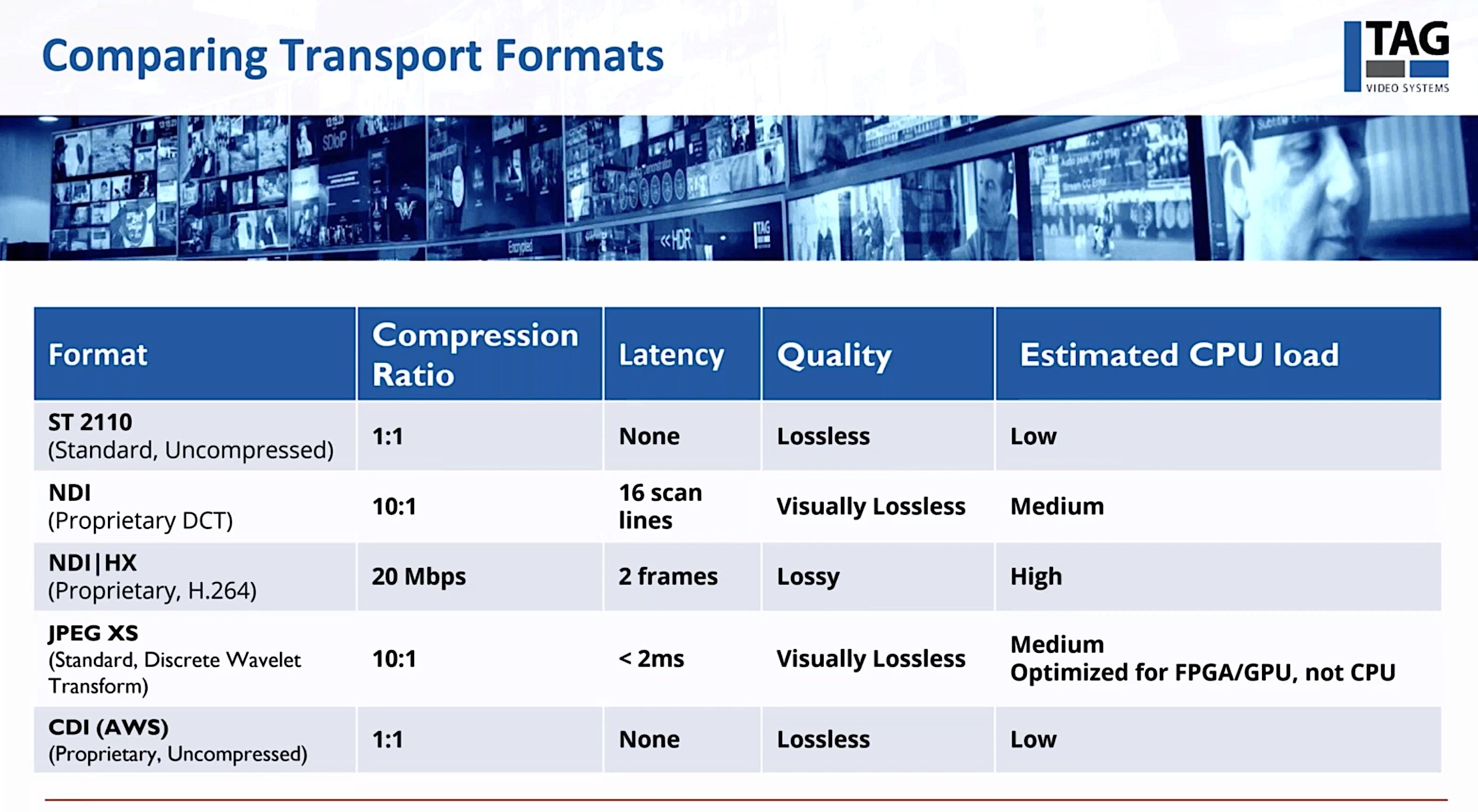
Tackling bandwidth, Peter looks at the low-latency ways to compress video such as NDI, NDI|HX, JPEG XS and Amazon’s lossless CDI. Peter talks us through some of the considerations in choosing the right codec for the task in hand.

Finishing his talk, Peter asks if this isn’t time for a radical change. Why not rethink the entire process and embrace latency? Peter gives an example of a colour grading workflow which has been able to switch from on-prem colour grading on very high-spec computers to running this same, incredibly intensive process in the cloud. The company’s able to spin up thousands of CPUs in the cloud and use spot pricing to create temporary, low cost, extremely powerful computers. This has brought waiting times down for jobs to be processed significantly and has reduced the cost of processing an order of magnitude.

Lastly Peter looks further to the future examining how saturating the stadium with cameras could change the way we operate cameras. With 360-degree coverage of the stadium, the position of the camera can be changed virtually by AI allowing camera operators to be remote from the stadium. There is already work to develop this from Canon and Intel. Whilst this may not be able to replace all camera operators, sports is the home of bleeding-edge technology. How long can it resist the technology to create any camera angle?

Source: intoPIX

Jean-Baptiste Lorent is next from intoPIX to explain what JPEG XS is. A new, ultra-low-latency, codec it meets the challenges of the industry’s move to IP, its increasing desire to move data rather than people and the continuing trend of COTS servers and cloud infrastructure to be part of the real-time production chain.

As Peter covered, uncompressed data rates are very high. The Tokyo Olympics will be filmed in 8K which racks up close to 80Gbps for 120fps footage. So with JPEG XS standing for Xtra Small and Xtra Speed, it’s no surprise that this new ISO standard is being leant on to help.

Tested as visually lossless to 7 or more encode generations and with latency only a few lines of video, JPEG XS works well in multi-stage live workflows. Jean-Baptiste explains that it’s low complexity and can work well on FPGAs and on CPUs.

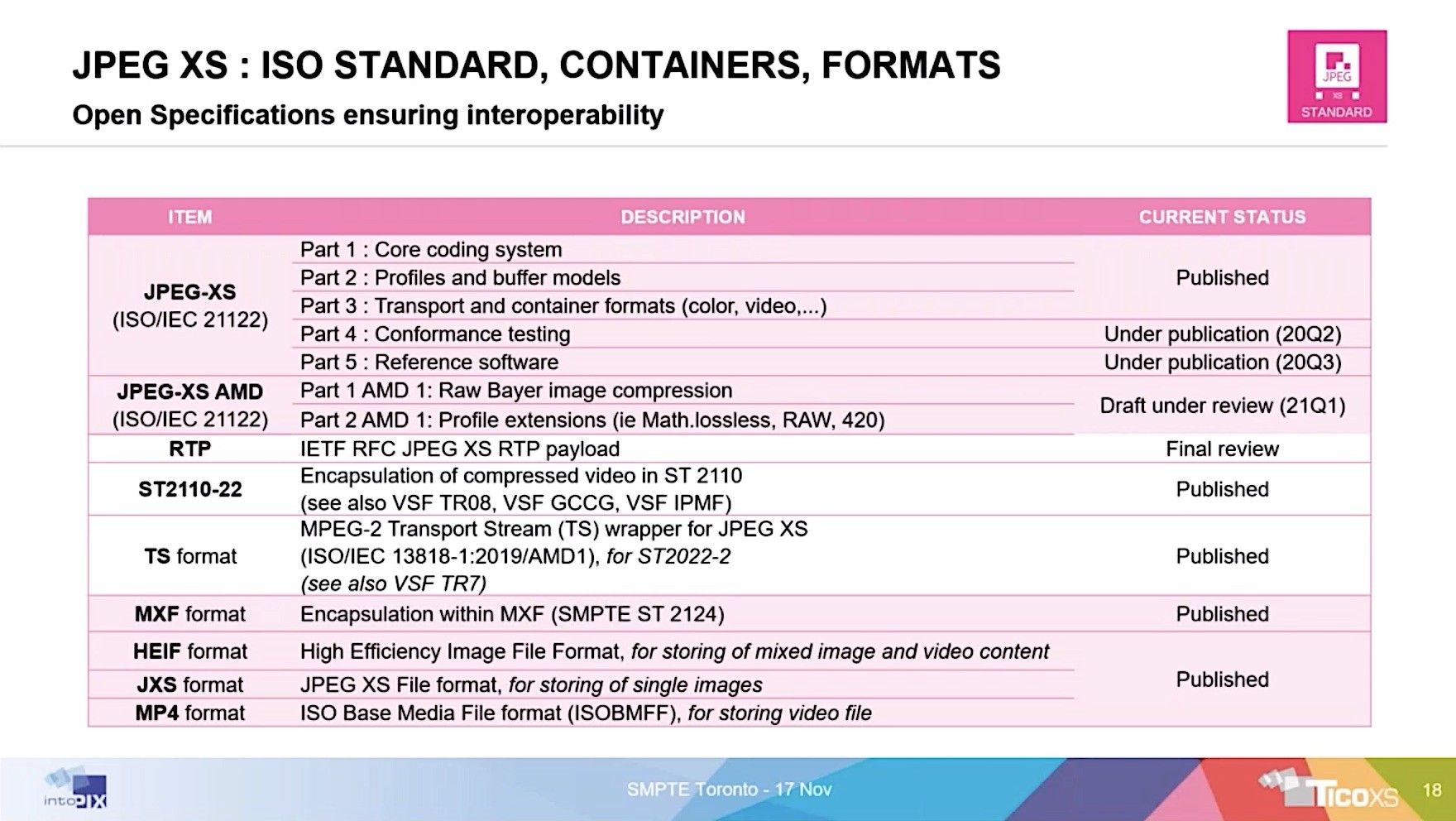
JPEG XS can support up to 16-bit values, any chroma and any colour space. It’s been standardised to be carried in MPEG TSes, in SMPTE ST 2110 as 2110-22, over RTP (pending) within HEIF file containers and more. Worst case bitrates are 200Mbps for 1080i, 390Mbps for 1080p60 and 1.4Gbps for 2160p60.

Evolution of Standards-Based IP Workflows Ground-To-Cloud

Last in the presentations is John Mailhot from Imagine Communications and also co-chair of an activity group at the VSF working on standardising interfaces for passing media place to place. Within the data plane, it would be better to avoid vendors repeatedly writing similar drivers. Between ground and cloud, how do we standardise video arriving and the data you need around that. Similarly standardising new technologies like Amazon’s CDI is important.

John outlines the aim of having an interoperability point within the cloud above the low-level data transfer, closer to 7 than to 1 in the OSI model. This work is being done within AIMS, VSF, SMPTE and other organisations based on existing technologies.

Q&A
The video finishes with a Q&A and includes comments from AWS’s Evan Statton whose talk on CDI that evening is not part of this video. The questions cover comparing NDI with JPEG XS, how CDI uses networking to achieve high bandwidths and high reliability, the balance between minimising network and minimising CPU depending on workflow, the increasingly agile nature of broadcast infrastructure, the need for PTP in the cloud plus the pros and cons of standards versus specifications.

Watch now!
Speakers

Peter Wharton Peter Wharton
Director Corporate Strategy, TAG V.S.
President, Happy Robotz
Vice President of Membership, SMPTE
Jean-Baptiste Lorent Jean-Baptiste Lorent
Director Marketing & Sales,
intoPIX
John Mailhot John Mailhot
Co-Chair Cloud-Gounrd-Cloud-Ground Activity Group, VSF
Directory & NMOS Steering Member, AMWA
Systems Architect for IP Convergence, Imagine Communcations
Paul Briscoe Moderator: Paul Briscoe
Canadian Regional Governor, SMPTE
Consultant, Televisionary Consulting
Evan Statton Evan Statton
Principal Architect, Media & Entertainment
Amazon Web Services