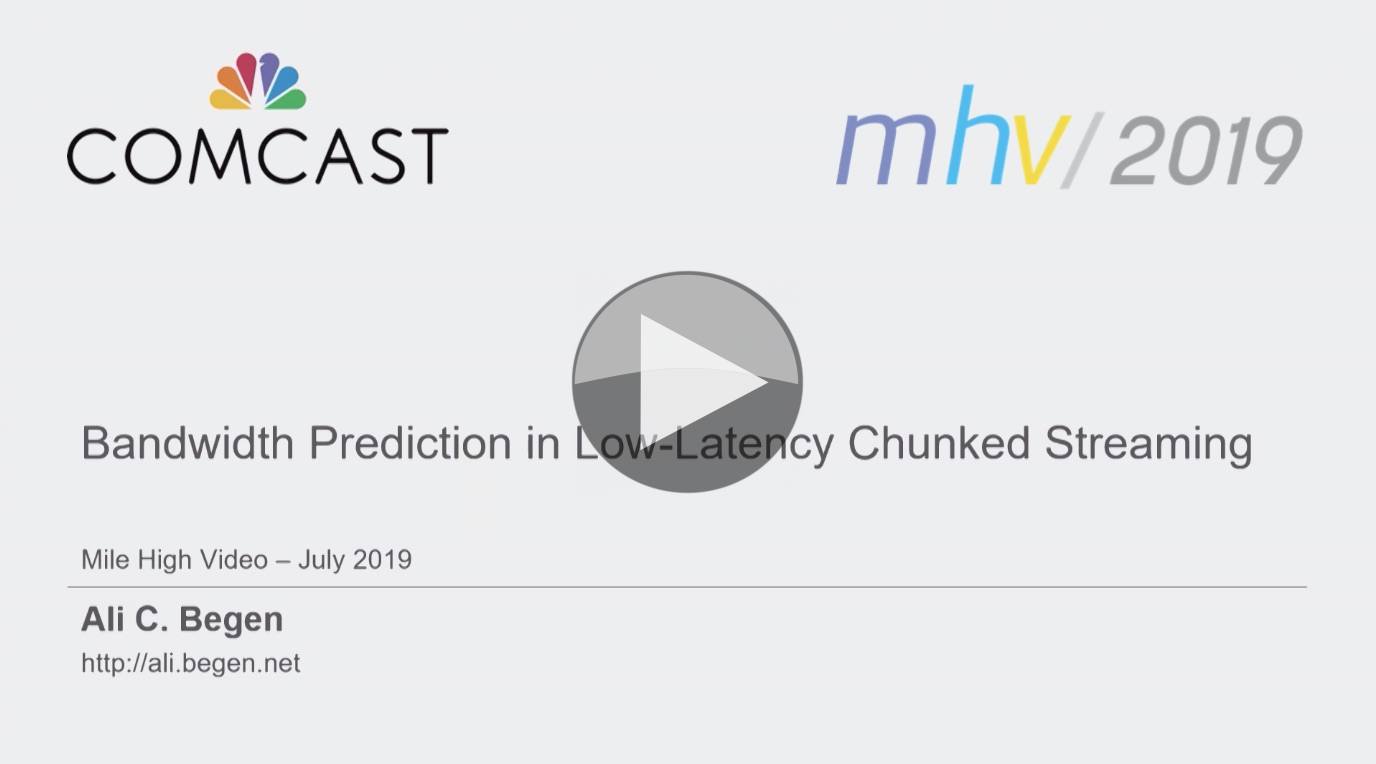
Video: Bandwidth Prediction in Low-Latency Chunked Streaming

How can we overcome one of the last, big, problems in making CMAF generally available: making ABR work properly.

ABR, Adaptive Bitrate is a technique which allows a video player to choose what bitrate video to download from a menu of several options. Typically, the highest bitrate will have the highest quality and/or resolution, with the smallest files being low resolution.

The reason a player needs to have the flexibility to choose the bitrate of the video is mainly due to changing network conditions. If someone else on your network starts watching some video, this may mean you can no longer download video quick enough to keep watching in full quality HD and you may need to switch down. If they stop, then you want your player to switch up again to make the most of the bitrate available.

Traditionally this is done fairly simply by measuring how long each chunk of the video takes to download. Simply put, if you download a file, it will come to you as quickly as it can. So measuring how long each video chunk takes to get to you gives you an idea of how much bandwidth is available; if it arrives very slowly, you know you are close to running out of bandwidth. But in low-latency streaming, your are receiving video as quickly as it is produced so it’s very hard to see any difference in download times and this breaks the ABR estimation.

Making ABR work for low-latency is the topic covered by Ali in this talk at Mile High Video 2019 where he presents some of the findings from his recently published paper which he co-authored with, among others, Bitmovin’s Christian Timmerer and which won the DASH-IF Excellence in DASH award.

He starts by explaining how players currently behave with low-latency ABR showing how they miss out on changing to higher/lower renditions. Then he looks at the differences on the server and for the player between non-low-latency and low-latency streams. This lays the foundation to discuss ACTE – ABR for Chunked Transfer Encoding.

ACTE is a method of analysing bandwidth with the assumption that some chunks will be delivered as fast as the network allows and some won’t be. The trick is detecting which chunks actually show the network speed and Ali explains how this is done and shows the results of their evaluation.

Watch now!

Speaker

Ali C. Begen Ali C. Begen
Technical Consultant and
Computer Science Professor

Video: The Past, Present and Future of AV1

AV1 has strong backing from tech giants but is still seldom seen in the wild. Find out what the plans are for the future with Google’s Debargha Mukherjee.

Debargha’s intent in this talk is simple: to frame a description of what AV1 can do and is doing today in terms of the history of the codec and looking forward to the future and a potential AV2.

The talk starts by demonstrating the need for better video codecs not least of which is the statistic that by 2021, 81% of the internet’s traffic is expected to be video. But on top of that, there is a frustration with the slow decade-long refresh process which is traditional for video codecs. In order to match the new internet landscape with fast-evolving services, it seemed appropriate to have a codec which, not only delivered better encoding but also saw a quicker five-year refresh cycle.

As a comparison to the royalty-free AV1, Debargha then looks at VP9 it is deployed. Furthermore, VP10 who’s development was stopped and diverted into the AV1 effort which is then the topic for the next part of the talk; the Alliance for Open Media, the standardisation process and then a look at some of the encoding tools available to archive the stated aims.

To round off the description of what’s presently happening with AV1 trials of VP9, HEVC and AV1 are shown demonstrating AV1s ability to improve compression for a certain quality. Bitmovin and Facebook’s tests are also highlighted along with speed tests.

Looking, now, to the future, the talk finishes by explaining the future roadmap for hardware decoding and other expected milestones in the coming years plus the software work such as SVT-AV1 and DAV1D for optimised encoding and decoding. With the promised five-year cycle, we need to look forward now to AV2 and Debargha discusses what it might be and what it would need to achieve.

Watch now!
Speaker

Debargha Mukherjee Debargha Mukherjee
Principal Software Engineer,
Google

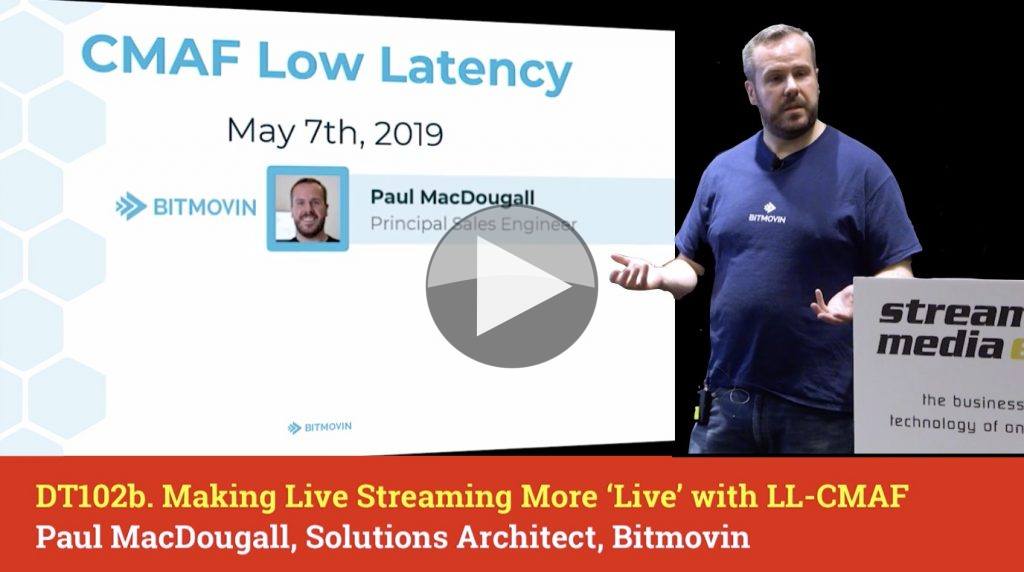
Video: Making Live Streaming More ‘Live’ with LL-CMAF

Squeezing streaming latency down to just a few seconds is possible with CMAF. Bitmovin guides us through what’s possible now and what’s yet to come.

CMAF represents an evolution of the tried and tested technologies HLS and DASH. With massive scalability and built upon the well-worn tenants of HTTP, Netflix and a whole industry was born and is thriving on these still-evolving technologies. But the push to reduce latency further and further has resulted in CMAF which can be used to deliver streams with five to ten times lower latencies.

Paul MacDougall is a Solutions Architect with Bitmovin so is well placed to explain the application of CMAF. Starting with a look at what we mean by low latency, he shows that it’s still quite possible to find HLS latencies of up to a minute but more common latencies now are closer to 30 seconds. But 5 seconds is the golden latency which matches many broadcast mechanisms including digital terrestrial, so it’s no surprise that this is where low latency CMAF is aimed.

CMAF itself is simply a format which unites HLS and DASH under one standard. It doesn’t, in and of itself, mean your stream will be low latency. In fact, CMAF was born out of MPEG’s MP4 standard – officially called ISO BMFF . But you can use CMAF in a low-latency mode which is what this talk focusses on.

Paul looks at what makes up the latency of a typical feed discussing encoding times, playback latency and the other key places. With this groundwork laid, it’s time to look at the way CMAF is chunked and formatted showing that the smaller chunk sizes allow the encoder and player to be more flexible reducing several types of latency down to only a few seconds.

In order to take full advantage of CMAF, the play needs to understand CMAF and Paul explains these adaptations before moving on to the limitations and challenges of using CMAF today. One important change, for instance, is that chunked streaming players (i.e. HLS) have always timed the download of each chunk to get a feel for whether bandwidth was plentiful (download was quicker than time taken to play the chunk) or bandwidth was constrained (the chunk arrived slower than real-time). Based on this, the player could choose to increase or decrease the bandwidth of the stream it was accessing which, in HLS, means requesting a chunk from a different playlist. Due to the improvements in downloading smaller chunks and using real-time transfer techniques such as HTTP/1.1 Chunked Transfer the chunks are all arriving at the download speed. This makes it very hard to make ABR work for LL-CMAF, though there are approaches being tested and trialed not mentioned in the talk.

Watch now!

Speakers

Paul MacDougall Paul MacDougall
Solutions Architect,
Bitmovin

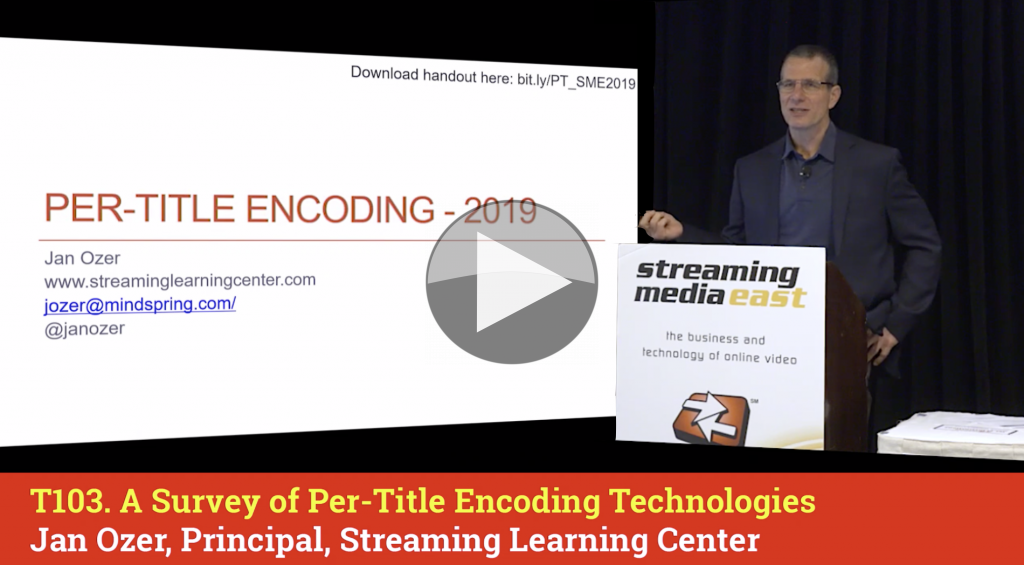
Video: A Survey Of Per-Title Encoding Technologies

Optimising encoding by per-title encoding is very common nowadays, though per-scene is slowly pushing it aside. But with so many companies offering per-title encoding, how do we determine which way to turn?

Jan Ozer experimented with them, so we didn’t have to. Jan starts by explaining the principles of per-title encoding and giving an overview of the market. He then explains some of the ways in which it works including the importance of changing resolution as much as changing

As well as discussing the results, with Bitmovin being the winner, Jan explains ‘Capped CRF’ – how it works, how it differs from CBR & VBR and why it’s good.

Finally, we are left with some questions to ask when searching for our own per-title technology to solve the problem we have such as “can it adjust rung resolutions?”, “Can you apply traditional data rate controls?” amongst others.

Watch now!

Speaker

Jan Ozer Jan Ozer
Principal,
Streaming Learning Center