Video: AV1/VVC Update

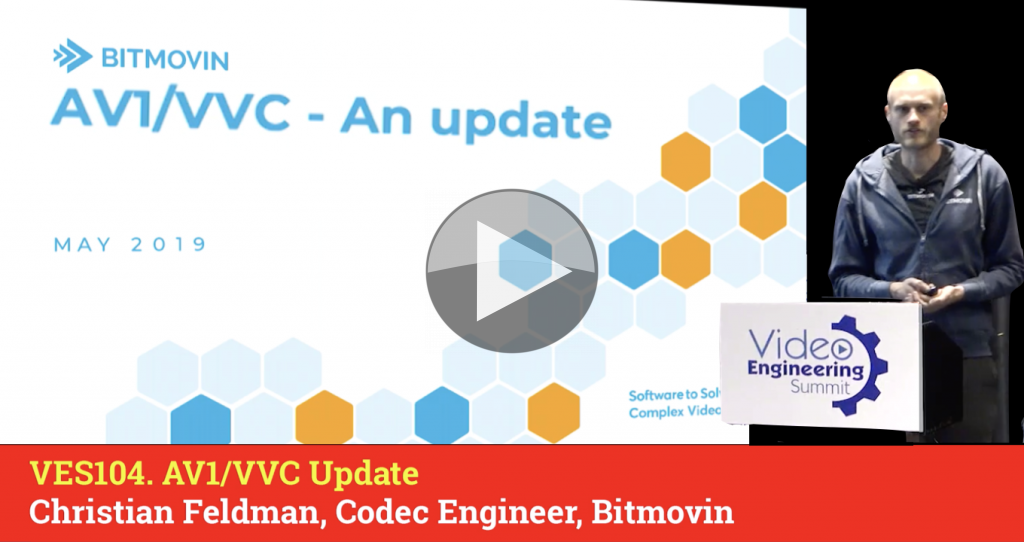
AV1 and VVC are both new codecs on the scene. Codecs touch our lives every day both at work and at home. They are the only way that anyone receives audio and video online and television. So all together they’re pretty important and finding better ones generates a lot of opinion.

So what are AV1 and VVC? VVC is one of the newest codecs on the block and is undergoing standardisation in MPEG. VVC builds on the technologies standardised by HEVC but adds many new coding tools. The standard is likely to enter draft phase before the end of 2019 resulting in it being officially standardised around a year later. For more info on VVC, check out Bitmovin’s VVC intro from Demuxed

AV1 is a new but increasingly known codec, famous for being royalty free and backed by Netflix, Apple and many other big hyper scale players. There have been reports that though there is no royalty levied on it, patent holders have still approached big manufacturers to discuss financial reimbursement so its ‘free’ status is a matter of debate. Whilst there is a patent defence programme, it is not known if it’s sufficient to insulate larger players. Much further on than VVC, AV1 has already had a code freeze and companies such as Bitmovin have been working hard to reduce the encode times – widely known to be very long – and create live services.

Here, Christian Feldmann from Bitmovin gives us the latest status on AV1 and VVC. Christian discusses AV1’s tools before discussing VVC’s tools pointing out the similarities that exist. Whilst AV1 is being supported in well known browsers, VVC is at the beginning.

There’s a look at the licensing status of each codec before a look at EVC – which stands for Essential Video Coding. This has a royalty free baseline profile so is of interest to many. Christian shares results from a Technicolor experiment.

Speakers

Christian Feldmann Christian Feldmann
Codec Engineer,
Bitmovin

Video: Scalable Video Coding in HEVC & AV1

While it has never played a big role in practical applications, scalable video coding has been around since the times of MPEG 2, and might actually have some advantages over the multi-rate transmission often applied today. The purpose of scalable coding is to efficiently compress multiple different versions of the same video in one “scalable” bitstream. Actually this sounds like the perfect solution for VOD and streaming applications, but unfortunately it has some downsides and few vendors ever used it. In this talk, Chrstian will review the basic idea of scalable coding, how it is enabled in modern coding standards and the pros and cons of implementing the technology in streaming applications.

Speaker

Christian Feldmann Chrisitan Feldmann
Codec Engineer,
Bitmovin

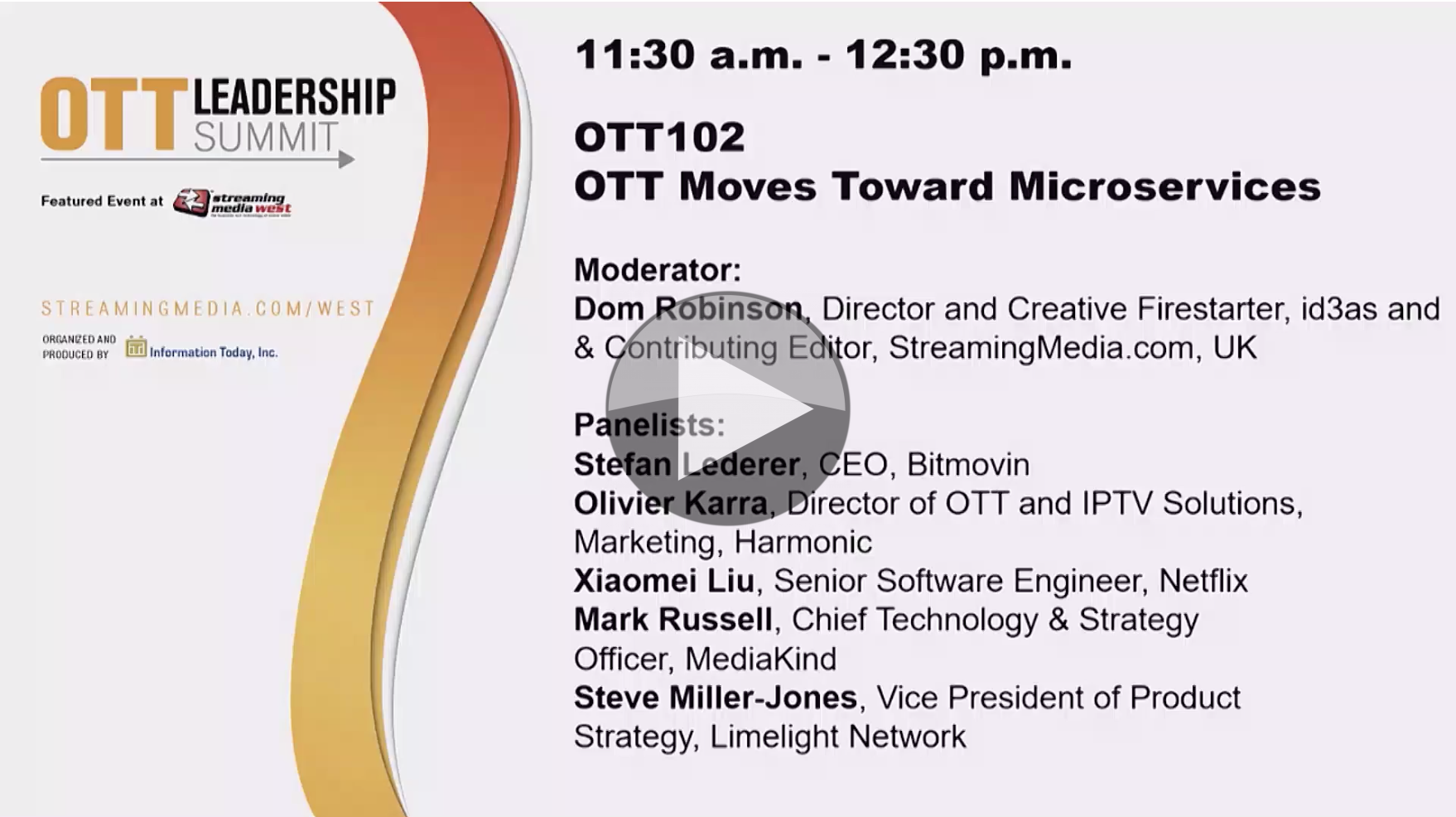
Video: OTT Moves Toward Microservices


Using microservices is a way of architecting your software platform to be nimble, simple and is just as applicable to on-premise platforms as cloud. As scaling is important for OTT providers, it’s not surprising that much work is being done in the OTT sector to utilise microservice architectures.

Even companies that are not yet actively operating on a microservices architecture are looking for vendors who at least have a strategy to cater to it for the future. This session will examine the core benefits (including redundancy, dev ops, scalability, and self-healing), the different approaches (including containerisation and orchestration via Docker, Kubernetes, and Mesos, as well as native microservices models like Erlang), and the complexities of migrating a generic architecture to a microservices architecture.

This panel covers:

    • Why is OTT so suited to microservices?
    • How microservices enable companies to be flexible to changing customer demands
    • How microservices reduce complexity
    • Benefits of continuous deployment

plus much more!

Watch now!

Moderator: Dom Robinson, Director and Creative Firestarter – id3as, UK & Contributing Editor, StreamingMedia.com, UK
Stefan Lederer, CEO & Co-Founder – Bitmovin, USA
Steve Miller-Jones, Vice President of Product Strategy – Limelight Networks, UK
Xiaomei Lio, Senior Software Engineer, Netflix
Mark Russell, Chief Technology & Strategy Officer, MediaKind
Olivier Karra, Directory of OTT & IPTV Solutions, Marketing, Harmonic Inc.

Webinar: CMAF Low Latency Webinar


Date: Jan 30th, 9am PT / 17:00 GMT
Now on demand!

Bitmovin presents a delve into CMAF – the new low-latency streaming protocol which promises online streaming latencies on-par with traditional broadcast.

Leaders in this space, Anevia, Bitmovin and Fastly come together to discuss whether the industry is in adopting CMAF, how you can implement it and how it works.

Watch now!