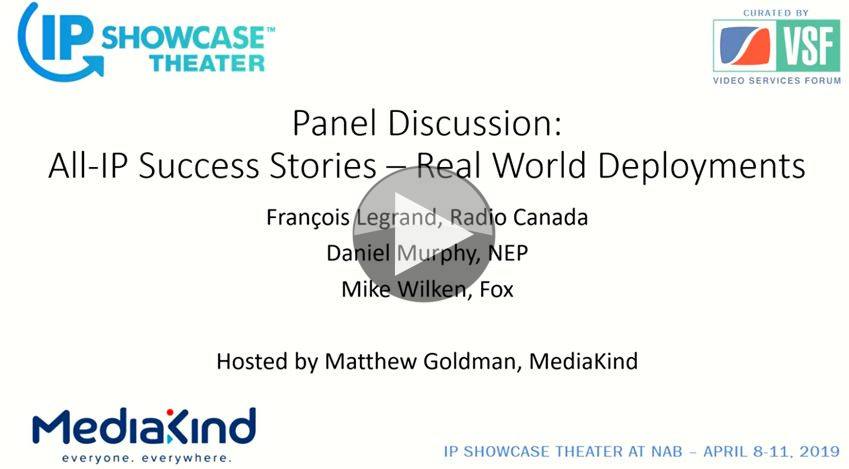
Video: All IP Success Stories Real World Deployments

When SDI came in to replace analogue video, there were difficulties and setbacks yet now it’s very well trusted and ubiquitous. Similarly, life is not simple moving from SDI into IP, either 2022-6 or 2110, let alone PTP which replaces black nad burst.

In this talk we hear from people who have made that change and are working with IP. We find out what went well, whether things are up and running yet and also what the challenges and lessons learnt are.

Speakers

Mike Wilken Mike Wilken
SVP of Systems and Technology,
FOX Sports
Francois Legrand Francois Legrand
Senior Project Mangaer,
CBC/Radio Canada
Daniel Murphy Daniel Murphy
NEP

Video: Implementing AES67 and ST 2110-30 in Your Plant

AES67 is a flexible standard but with this there is complexity and nuance. Implementing it within ST 2110-30 takes some care and this talk covers lessons learnt in doing exactly that.

AES67 is a standard defined by the Audio Engineering Society to enable high-performance audio-over-IP streaming interoperability between various AoIP systems like Dante, WheatNet-IP and Livewire. It provides comprehensive interoperability recommendations in the areas of synchronization, media clock identification, network transport, encoding and streaming, session description, and connection management.

The SMPTE ST 2110 standards suite makes it possible to separately route and break away the essence streams – audio, video, and ancillary data. ST 2110-30 addresses system requirements and payload formats for uncompressed audio streams and refers to the subset of AES67 standard.

In this video Dominic Giambo from Wheatsone Corporation discusses tips for implementing AES67 and ST 2110-30 standards in a lab environment consisting of over 160 devices (consoles, sufraces, hardware and software I/O blades) and 3 different automation systems. The aim of the test was to pass audio through every single device creating a very long chain to detect any defects.

The following topics are covered:

  • SMPTE ST 2110-30 as a subset of AES67 (support of the PTP profile defined in SMPTE ST 2059-2, an offset value of zero between the media clock and the RTP stream clock, option to force a device to operate in PTP slave-only mode)
  • The importance of using IEEE-1588 PTP v2 master clock for accuracy
  • Packet structure (UDP and RTP header, payload type)
  • Network configuration considerations (mapping out IP and multicast addresses for different vendors, keeping all devices on the same subnet)
  • Discovery and control (SDP stream description files, configuration of signal flow from sources to destinations)

Watch now!

You can download the slides here.

Speaker

Dominic Giambo
Senior Embedded Engineer
Wheatstone Corporation

Video: Monitoring and Measuring IP Media Networks

nn

The transition from point-to-point SDI based infrastructure to IP essence flows requires a very different approach to fault-finding. Although new IP diagnostic tools are already available on the market, engineers need combined broadcast and IT knowledge to fully understand the flow of video, audio and data across the switching fabric – including packet jitter, latency, and buffer over/underflows causing dropped packets.

In this video Michael Waidson from Tektronix presents methodologies involved in monitoring IP media networks. The following topics are covered:

  • Strategies for choosing IP Address, Port Number and Payload Type for easier identification of the streams
  • Troubleshooting basics (fibres and SFPs types, checking switch ports)
  • PTP synchronisation
  • Checking syntax of decoded streams (Layer 5 RTP, Marker Bit, Payload Type, Sequence Number, Timestamp)
  • Packet transmission (multiple paths, out of order packets in receiver, jitter, PIT Histogram)
  • Timing (reference clock, RTP timestamps, checking PTP lock, PTP and RTP offset, transmission traffic shape models)

You can download the slides here.

Speaker

Michael Waidson
Application Engineer
Tektronix

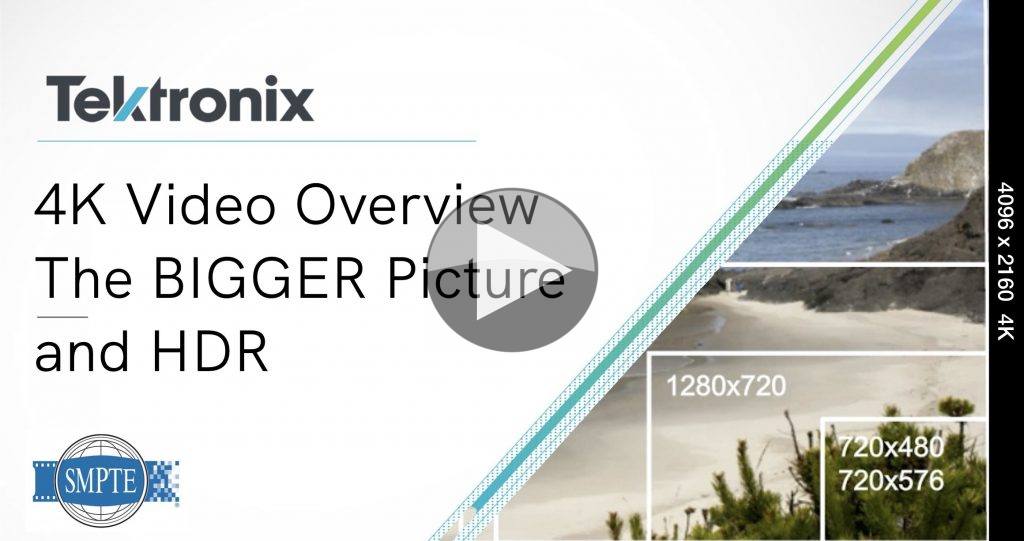
Video: Intro to 4K Video & HDR

With all the talk of IP, you’d be wrong to think SDI is dead. 12G for 4K is alive and well in many places, so there’s plenty of appetite to understand how it works and how to diagnose problems.

In this double-header, Steve Holmes from Tektronix takes us through the ins and outs of HDR and also SDI for HDR at the SMPTE SF section.

Steve starts with his eye on the SMPTE standards for UHD SDI video looking at video resolutions and seeing that a UHD picture can be made up of 4 HD pictures which gives rise to two well-known formats ‘Quad split’ and ‘2SI’ (2 Sample Interleave).

Colour is the next focus and a discussion on the different colour spaces that UHD is delivered with (spoiler: they’re all in use), what these look like on the vectorscope and look at the different primaries. Finishing up with a roundup and a look at interlink timing, there’s a short break before hitting the next topic…HDR

High Dynamic Range is an important technology which is still gaining adoption and is often provided in 4K programmes. Steve defines the two places HDR is important; in the acquisition and the display of the video then provides a handy lookup table of terms such as HDR, WCG, PQ, HDR10, DMCVT and more.

Steve gives us a primer on what HDR is in terms of brightness ‘NITS’, how these relate to real life and how we talk about it with respect to the displays. We then look at HDR on the waveform monitor and look at features of waveform monitors which allow engineers to visualise and check HDR such as false colour.

The topic of gamma, EOTFs and colour spaces comes up next and is well-explained building on what came earlier. Before the final demo and Q&A, Steve talks about different ways to grade pictures when working in HDR.

A great intro to the topics at hand – just like Steve’s last one: Uncompressed Video over IP & PTP Timing

Watch now!

Speakers
Steve Holmes Steve Holmes
Former Senior Applications Engineer,
Tektronix