Video: ST 2110-30 and NMOS IS-08 — Audio Transport and Routing

Andreas Hildebrand starts by introducing 2110 and how it works in terms of sending the essences separately using multicast IP. This talk focusses on the ability of audio-only devices to subscribe to the audio streams without needing the video streams. Andreas then goes on to introduce AES67 which is a standard defining interoperability for audio defining timing, session description, encoding, QOS, transport and much more. Of all the things which are defined in AES67, discovery was deliberately not included and Andreas explains why.

Within SMPTE 2110, there are constraints added to AES67 under the sub-standard 2110-30. The different categories A, B and C (and their X counterparts) are explained in terms how how many audios are defined and the sample lengths with their implications detailed.

As for discovery and other aspects of creating a working system, Andreas looks towards AMWA’s NMOS suite summarising the specifications for Discovery & Registration, Connection Management, Network Control, Event & Tally, Audio Channel Mapping. It’s the latter which is the focus of the last part of this talk.

IS-08 defines a way of defining input and output blocks allowing a channel mapping to be defined. Using IS-05, we can determine which source stream should connect to which destination device. Then IS-08 gives the capability to determine which of the audios within this stream can be mapped to the output(s) of the receiving device and on top of this allows mapping from multiple received streams into the output(s) of one device. The talk then finishes with a deeper look at this process including where example code can be found.

Watch now!

Speaker

Andreas Hildebrand Andreas Hildebrand
Senior Product Manager,
ALC NetworX

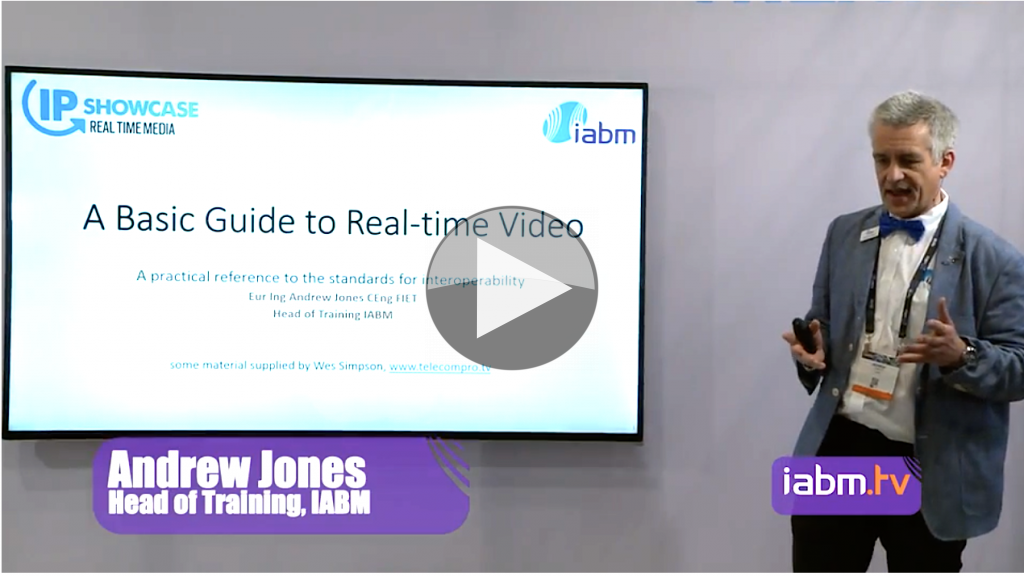
Video: A Basic Guide For Real-Time IP Video

There are a lot of videos looking into the details of uncompressed video over IP, but not many for those still starting out – and let’s face it, there are a lot of people who are only just embarking on this journey. Here, Andy Jones takes us through the real basics do prove very useful as a building block for understanding today’s IP technologies.

Andy Jones is well known by many broadcast engineers in the UK having spent many many years working in The BBC’s Training and Development department and subsequently running training for the IABM. The news that he passed away on Saturday is very saddening and I’m posting this video in recognition of the immense amount he has contributed to the industry through his years of tireless work. You can see from this video from NAB 2018 his passion, energy and ability to make complicated things simple.

In this talk, Andy looks at the different layers that networks operate on, including the physical layer i.e. the cables. This is because the different ways in which traffic gets from A to B in networking are interdependent and need to be considered as such. He looks at an example network which shows all the different standards in use in an IP network and talks about their relevance.

Andy briefly looks at IP addresses and the protocol that makes them work. This underpins much of what happens on most networks before looking at the Real-time Transport Protocol (RTP) which is heavily used for sending audio and video streams.

After looking at how timing is done in IP (as opposed to black and burst) he has laid enough foundations to look at SMPTE ST 2110 – the suite of standards which show how different media (essences) are sent in networks delivering uncompressed streams. AES67 for the audio is also looked at before how to control the whole kit and caboodle.

A great primer for those starting out, watch now!

Speaker

Andy Jones Andy Jones

Webinar: IP for Media Part 4 – Audio

Date: Thursday 21st March 2019
Time: 2PM EDT / 18:00 GMT

The fourth in the series of IP in broadcasting, Wes Simpson, NewTek and TV Technology are back, this time, to discuss using Audio over IP – specifically uncompressed audio over IP.

There are a number of proprietary systems like Dante, RAVENNA and others, but this webinar focusses on the standardised AES67 and the closely linked SMPTE ST 2110-30 standards.

Register here for this webinar and the previous IP ones which cover Security, Remote Production and the first ‘101’ session covering the basics of compressed and uncompressed IP for broadcasting.

Speakers

Wes Simpson Wes Simpson
President,
Telecom Product Consulting
Will Waters Will Waters
Vice President of Customer Success,
NewTek
Tom Butts Tom Butts
Content Director,
TV Technology

Video: The Audio Parts of ST 2110 Explained

At the IBC 2018 IP Showcase, Andreas Hildebrand explains how AES67 and 2110 work together and how technologies like Dante, RAVENNA and Livewire fit in.

While there are lots of resources for working with 2110 video, but this is one of the few which tackles Audio. Andreas covers one of the ‘gotchas’ in 2110 – the compatability requirements for AES within the standard. He then looks at the timing requirements of 2110 and how they differ to those of AES67 and finally discusses AES3 while explaining the ST 2110-31 standard.

Presenter

Andreas Hildebrand Andreas Hildebrand
Senior Product Manager and Evangelist for the RAVENNA technology developed by ALC NetworX, Germany,