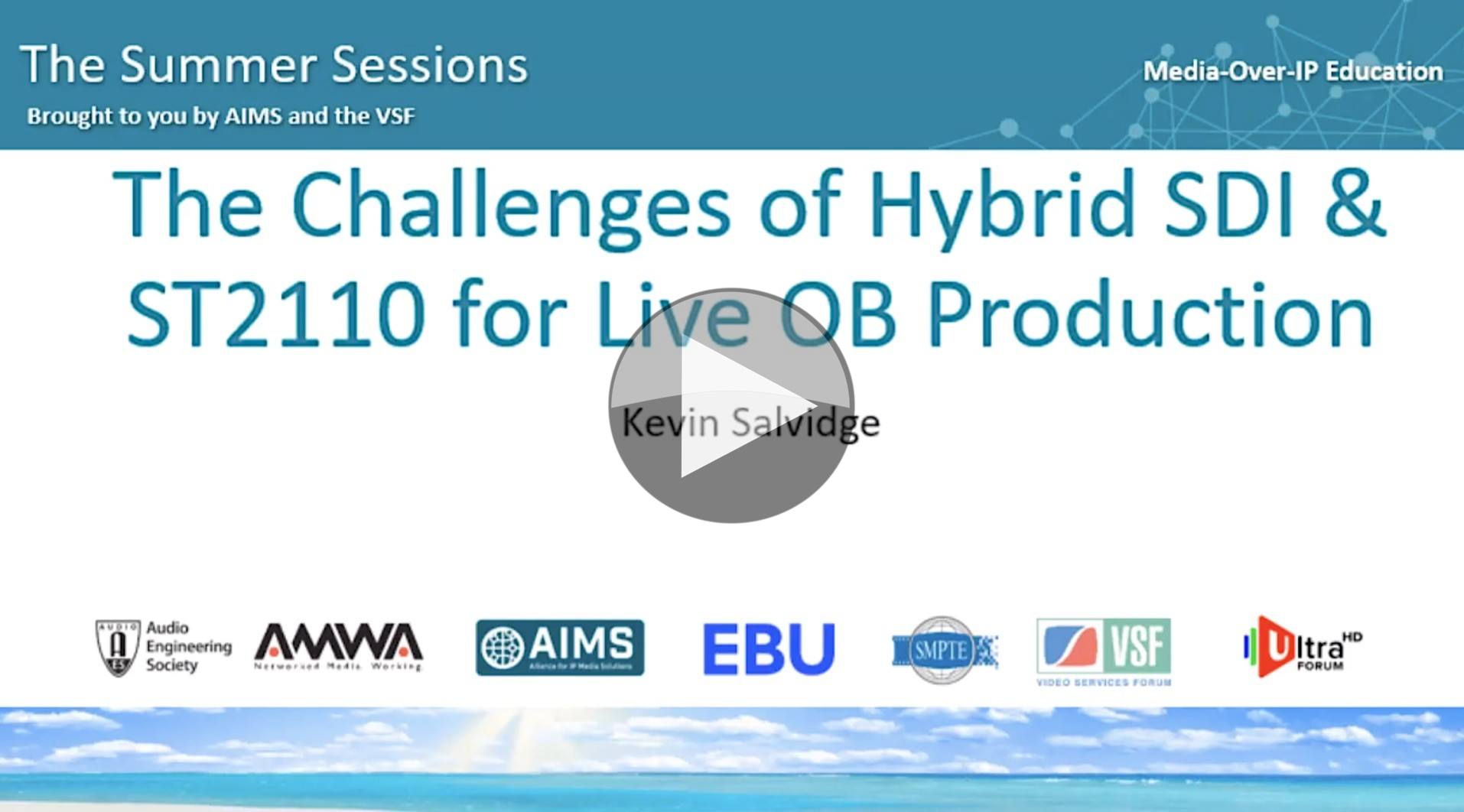
Video: Hybrid SDI/ST 2110 Workflows

It’s no secret that SDI is still the way to go for some new installations. For all the valid interest in SMPTE’s ST 2110, the cost savings are only realised either on a large scale or in the case that a system needs continuous flexibility (such as an OB truck) or scalability in the future. Those installations which have gone IP still have some SDI lying around somewhere. Currently, there are few situations where there is an absolute ‘no SDI’ policy because there are few business cases which can afford it.

Looking at the current deployments of broadcast 2110, we have large, often public, broadcasters who are undergoing a tech refresh for a building and can’t justify such as massive investment in SDI or they are aiming to achieve specific savings such as Discovery’s Eurosport Transformation Project which is an inspirational, international project to do remote production for whole buildings. We also have OB trucks who benefit significantly from reduced cabling, higher density routing and flexibility. For a more detailed view on 2110 in trucks, watch this video from NEP. In these scenarios, there is nearly always SDI still involved. Some equipment doesn’t yet work fully in 2110, some doesn’t yet work at all and while there are IP versions of some products, the freelance community still needs to learn how to use the new products or work in the new workflows. If you have a big enough project, you’ll hit the ‘vendor not yet ready’ problem, if you have an OB-truck or similar, you are likely to have to deal with the freelance experience issue. Both are reducing, but are still real and need to be dealt with.

Kevin Salvidge from Leader joins the VSF’s Wes Simpson to share his experience of these SDI/IP mixed workflows, many of which are in OB trucks so also include mixed HDR workflows. He starts by talking about PTP and GPS discussing how timing needs to be synced between locations. He then takes a closer look at the job of the camera shaders who make sure all the cameras have the same colour, exposure etc. Kevin talks about how live production in HDR and SDR work touching on the problem of ‘immediacy’. Shaders need to swap between cameras quickly and are used to the immediate switch that SDI can provide. IP can’t offer quite the same immediacy, Kevin says that some providers have added delays into the SDI switches to match the IP switch times within the same truck. This helps set expectations and stop operators pressing two or more times to get a switch made.

Kevin finishes his talk on the topic of synchronising analogue timing signals with PTP. Kevin shows us the different tools you can use to monitor these signals such as a display of PTP timing against B&B timing, a BMCA data readout of data from the PTP grandmasters to check if the BMCA algorithm is working correctly, PTP delay time, packet inter-arrival time, path delay, traffic shaping monitoring. He then closes with a Q&A talking about the continued prevalence of SDI, what ‘eye patterns’ are in the IP world and increasing HDR roll-outs.

Watch now!
Speaker

Kevin Slavidge
European Regional Development Manager
Leader Europe Ltd.
Wes Simpson Moderator: Wes Simpson
President, Telcom Product Consulting
Owner, LearnIPVideo.com

Video: The 2020 EBU Pyramid of User Requirements

There’s a lot more to IP-based production than just getting your video and audio streaming between devices. You need configuration tools, you need timing, there’s the management of the devices to consider and, critically, security. the problem is, working in IP is still new and many of the solutions are yet to mature. This means we still don’t have all the tools we need to realise the full promise of live production IP systems.

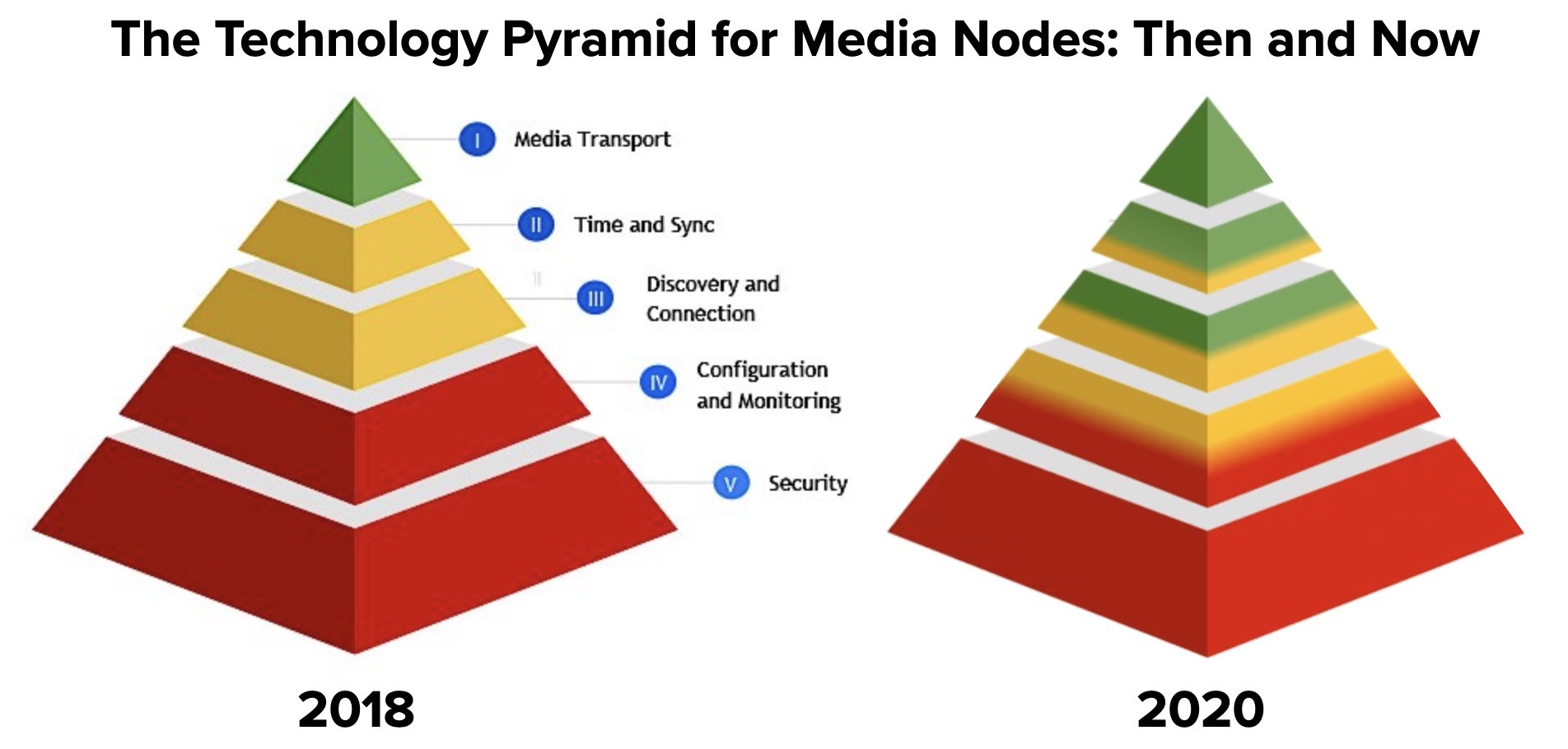
Back in 2018, the EBU embarked on a project to focus the industry on the gaps: The Technology Pyramid. This pyramid shows that although we, as an industry, had largely succeeded in defining essence transport over IP, this was only the ‘top of the iceberg’, so to speak, in what needed to be done. also known by its full name, “The Technology Pyramid for Media Nodes 2018”, it shows that everything is underpinned by security, upon that is configuration and monitoring, with discovery and registration built on that.

One important aspect of the pyramid is the green – yellow – red colour coding. When initially released, the only green was the transport layer, but this talk looks at the 2020 edition of the pyramid which shows that the time & sync, as well as discovery and connection, have improved.

We’re joined by Willem Vermost and Félix Poulin to discuss the problems the industry has faced to date and the progress made in making the pyramid green. Both previously with the EBU and now both with early-adopter broadcasters who are going live with IP systems, they are perfectly placed to explain the evolution on of the market.

Not only has the colouring of the pyramid changed, but the detail of what each layer constitutes has evolved. The industry has reacted with a number of specifications such as JT-NM TR-1001-1 and AMWA BCP-003. Willem and Félix explain the hidden necessities that have come out of the woodwork as the early adopters have fought to make everything work. PTP is a good example, being able to free-wheel without a PTP clock for 5 minutes and then join back without a glitch has been added to the list of requirements. Time stamping and lip-sync have proven tricky, too. Intermediate processing steps place their timestamps over the original timestamp of when the media was captured. If you are trying to sync audio and video which have gone through processing, you need the original timestamps which have now been lost. This problem is being addressed but until it is, it’s a big gap.

Overall we can see the power of focussing people’s attention in this way. Whilst there is much more detail in the talk itself, just from the extracts in this article, it’s clear progress has been made and with plenty more broadcasters starting their IP projects, there is all the more motivation for the vendors to implement the requirements as laid out than there was before.

Watch now!
Speakers

Willem Vermost Willem Vermost
Design & Engineering Manager,
VRT
Félix Poulin Félix Poulin
Direcor – Media Transport Architecture & Lab
CBC/Radio-Canada

Video: ST 2110 Testing Fundamentals

When you’ve chosen to go IP in your facility using ST 2110, you’ll need to know how to verify it’s working correctly, how to diagnose problems and have the right tools available. Vendors participate in several interop tests a year, so we can learn from how they set up their tests and the best practices they develop.

In this talk, Jean Lapierre explains what to test for and the types of things that typically go wrong in ST 2110 systems with PTP. Jean starts by talking about the parts of 2110 which are tested and the network and timing infrastructure which forms the basis of the testing. He then starts to go through problems to look for in deployments.

Jean talks about testing that IGMPv3 multicasts can be joined and then looks at checking the validity of SDP files which can be done by visual inspection and also SDPoker. A visual inspection is still important because whilst SDPoker checks the syntax, there can be basic issues in the content. 2022-7 testing is next. The simplest test is to turn one path off and check for disturbances, but this should be followed up by using a network emulator to deliver a variety of different types of errors of varying magnitudes to ensure there are no edge cases.

ST 2110 uses PTP for timing so, naturally, the timing system also needs to be tested. PTP is a bi-directional system for providing time to all parts of the network instead of a simple waterfall distribution of a centrally created time signal like black and burst. Whilst this system needs monitoring during normal operation, it’s important to check for proper grandmaster failover of your equipment.

PTP is also important when doing 2110 PCAPs in order to have accurate timing and to enable analysis with the EBU’s LIST project. Jean gives some guidelines on using and installing LIST and finishes his talk outlining some of the difficulties he has faced, providing tips on what to look out for.

Watch now!
Speakers

Jean Lapierre Jean Lapierre
Senior Director of Engineering,
Matrox

Video: Audio networking – ask anything you want!

It’s open season with these AES67 audio-over-Ip experts who are all the questions put to them on working with AES67. Not only was AES67 baked in to SMPTE ST 2110-30, it’s also a standard that brings compatability between Dante and RAVENNA as well as other AoIP technologies.

After a quick summary of what AES66 is, this talk quickly moves into answering these, and other questions:

  • How much bandwidth does stereo AES67 require?
  • Can multicast be used within Ravenna
  • Will there be a slipless switching/2022-7 style function?
  • Should receivers automatically adjust to original stream
  • Is it possible to avoid using PTP in an audio-only system?
  • Cost of PTP-capable switches
  • What’s the difference between Boundary Clocks and Transparent Clocks
  • Can AES67 go over the internet?
  • Tools for spotting problems
  • IPMX for Pro-AV update (See this talk)
  • Is NMOS ‘the answer’ for discovery and configuration?
  • Latency for Ravenna and AES67
  • New advancements in the PTP standard.

Watch now!
Speakers

Andreas Hildebrand Andreas Hildebrand
Evangelist,
ALC NetworX
Claude Cellier Claude Cellier
President & CEO
Merging Technologies SA
Claudio Becker-Foss
CTO,
DirectOut
Daniel Boldt Daniel Boldt
Head of Software Development,
Meinberg
Terry Holton Terry Holton
Audio subgroup Chairman,
AIMS
Roland Hemming Moderator: Roland Hemming
Audio Consultant
RH Consulting