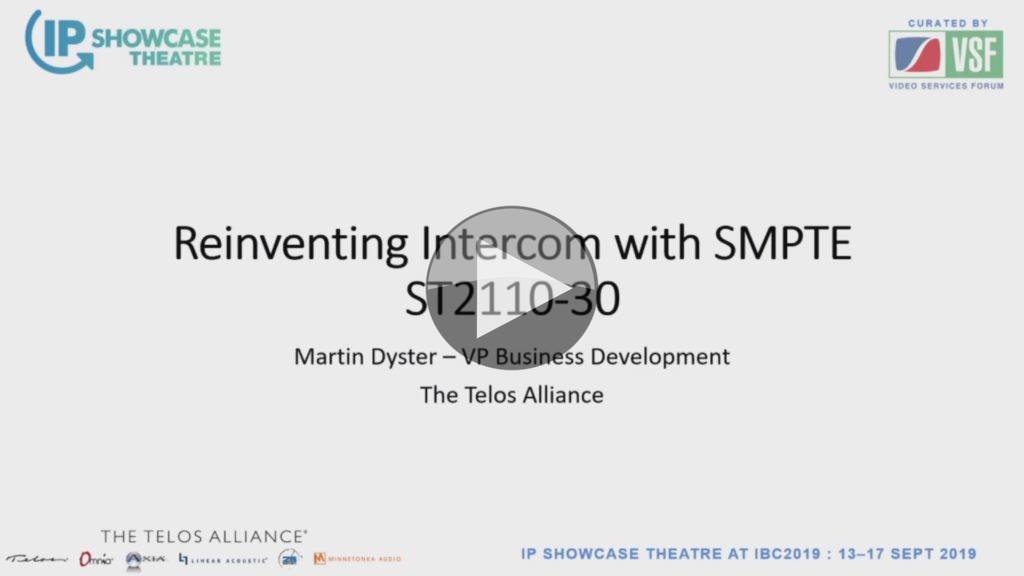
Video: Reinventing Intercom with SMPTE ST 2110-30

Intercom systems form the backbone of any broadcast production environment. There have been great strides made in the advancement of these systems, and matrix intercoms are very mature solution now, with partylines, IFBs and groups, wide range of connectivity options and easy signal monitoring. However, they have flaws as well. Initial cost is high and there’s lack of flexibility as system size is limited by the matrix port count. It is possible to trunk multiple frames, but it is difficult, expensive and takes rack space. Moreover, everything cables back to a central matrix which might be a single point of failure.

In this presentation, Martin Dyster from The Telos Alliance looks at the parallels between the emergence of Audio over IP (AoIP) standards and the development of products in the intercom market. First a short history of Audio over IP protocols is shown, including Telos Livewire (2003), Audinate Dante (2006), Wheatstone WheatNet (2008) and ALC Networks Ravenna (2010). With all these protocols available a question of interoperability has arisen – if you try to connect equipment using two different AoIP protocols it simply won’t work.

In 2010 The Audio Engineering Society formed the x192 Working Group which was the driving force behind the AES67. This standard was ratified in 2013 and allowed interconnecting audio equipment from different vendors. In 2017 SMPTE adapted AES67 as the audio format for ST 2110 standard.

Audio over IP replaces the idea of connecting all devices “point-to-point” with multicast IP flows – all devices are connected via a common fabric and all audio routes are simply messages that go from one device to another. Martin explains how Telos were inspired by this approach to move away from the matrix based intercoms and create a distributed system, in which there is no central core and DSP processing is built in intercom panels. Each panel contains audio mix engines and a set of AES67 receivers and transmitters which use multicast IP flows. Any ST 2110-30 / AES67 compatible devices present on the network can connect with intercom panels without an external interface. Analog and other baseband audio needs to be converted to ST 2110-30 / AES67.

Martin finishes his presentation by highlighting advantages of AoIP intercom systems, including lower entry and maintenance cost, easy expansion (multi studio or even multi site) and resilient operation (no single point of failure). Moreover, adaptation of multicast IP audio flows removes the need for DAs, patch bays and centralised routers, which reduces cabling and saves rack space.

Watch now!

Download the slides.

If you want to refresh your knowledge about AES67 and ST2110-30, we recomend the Video: Deep Dive into SMPTE ST 2110-30, 31 & AES 67 Audio presentation by Leigh Whitcomb.

Speaker

Martin Dyster
VP Business Development
The Telos Alliance

Video: Integrating CMAF Into A VOD Workflow

CMAF is often seen as the best hope for streaming to match the latency of broadcast. Fully standards based, many see this as the best route over Apple’s LL-HLS. Another benefit of it over LL-HLS is that it’s already a completed standard with growing support.

This talk from Tomas Bacik starts by explaining CMAF to us. Standing for the Common Media Application Format, it’s based on the standardised ISOBMFF container format and whilst CMAF isn’t by default low-latency, it is flexible enough to deliver just that. However, as Tomas from CDN77 points out, there are other major benefits in terms of its use of the Common Encryption format, reduces storage fees and more.

MPEG DASH is a commonly found streaming format based on ISO BMFF. It has always had the benefit of supporting other codecs such as HEVC and AV1 over HLS which is an AVC-only specification. CMAF is an extension of MPEG DASH which goes one step further in that it can deal with both HLS-style manifest files (.hls) as well as MPEG DASH format (.mpd) inheriting, of course, the multi-codec ability of DASH itself.

Next is central theme of the talk, looking at VoD workflows showing how CMAF fits in and, indeed, changes workflows for the better. CMAF directly impacts packaging, storage and CDN which is where we focus now. Given that some devices can play HLS and some can play DASH, if you try to serve both, you will double your requirements of packaging, storage etc. Dynamic packaging allows for immediately repackaging your chunks into either HLS or DASH as needed. Whilst this reduces the storage requirements, it increases processing and also increases the time to first byte. As you might expect, using CMAF throughout, Tomas explains in this talk, allows you to package once and store once which solves these problems.

Tomas continues by explaining the DRM abilities of CMAF including AES-CBC and finishes by taking questions from the audience.

Watch now!
See Streamflow’s blog post supporting the talk
Speakers

Tomas Bacik Tomas Bacik
VP of Product Development, Streamflow by CDN77
CDN77

Video: The Basics of SMPTE ST 2110 in 60 Minutes

SMPTE ST 2110 is a growing suite of standards detailing uncompressed media transport over networks. Now at 8 documents, it’s far more than just ‘video over IP’. This talk looks at the new ways that video can be transported, dealing with PTP timing, creating ‘SDPs’ and is a thorough look at all the documents.

Building on this talk from Ed Calverley which explains how we can use networks to carry uncompressed video, Wes Simpson goes through all the parts of the ST 2110 suite explaining how they work and interoperate as part of the IP Showcase at NAB 2019.

Wes starts by highlighting the new parts of 2110, namely the overview document which gives a high level overview of all the standard docs, the addition of compressed bit-rate video carriage and the recommended practice document for splitting a single video and sending it over multiple links; both of which are detailed later in the talk.

SMPTE ST 2110 is fundamentally different, as highlighted next, in that it splits up all the separate parts of the signal (i.e. video, audio and metadata) so they can be transferred and processed separately. This is a great advantage in terms of reading metadata without having to ingest large amounts of video meaning that the networking and processing requirements are much lighter than they would otherwise be. However, when essences are separated, putting them back together without any synchronisation issues is tricky.

ST 2110-10 deals with timing and knowing which packets of one essence are associated with packets of another essence at any particular point in time. It does this with PTP, which is detailed in IEEE 1588 and also in SMPTE ST 2059-2. Two standards are needed to make this work because the IEEE defined how to derive and carry timing over the network, SMPTE then detailed how to match the PTP times to phases of media. Wes highlights that care needs to be used when using PTP and AES67 as the audio standard requires specific timing parameters.

The next section moves into the video portion of 2110 dealing with video encapsulation on the networks pixel grouping and the headers needed for the packets. Wes then spends some time walking us through calculating the bitrate of a stream. Whilst for most people using a look-up table of standard formats would suffice, understanding how to calculate the throughput helps develop a very good understanding of the way 2110 is carried on the wire as you have to take note not only of the video itself (4:2:2 10 bit, for instance) but also the pixel groupings, UDP, RTP and IP headers.

Timing of packets on the wire isn’t anything new as it is also important for compressed applications, but it is of similar importance to ensure that packets are sent properly paced on wire. This is to say that if you need to send 10 packets, you send them one at a time with equal time between them, not all at once right next to each other. Such ‘micro bursting’ can cause problems not only for the receiver which then needs to use more buffers, but also when mixed with other streams on the network it can affect the efficiency of the routers and switches leading to jitter and possibly dropped packets. 2110-21 sets standards to govern the timing of network pacing for all of the 2110 suite.

Referring back to his warning earlier regarding timing and AES67, Wes now goes into detail on the 2110-30 standard which describes the use of audio for these uncompressed workflows. He explains how the sample rates and packet times relate to the ability to carry multiple audios with some configurations allowing 64 audios in one stream rather than the typical 8.

‘Essences’, rather than media, is a word often heard when talking about 2110. This is an acknowledgement that metadata is just as important as the media described in 2110. It’s sent separately as described by 2110-40. Wes explains the way captions/subtitles, ad triggers, timecode and more can be encapsulated in the stream as ancillary ‘ANC’ packets.

2110-22 is an exciting new addition as this enables the use of compressed video such as VC-2 and JPEG-XS which are ultra low latency codecs allowing the video stream to be reduced by half, a quarter or more. As described in this talk the ability to create workflows on a single IP infrastructure seamlessly moving into and out of compressed video is allowing remote production across countries allowing for equipment to be centralised with people and control surfaces elsewhere.

Noted as ‘forthcoming’ by Wes, but having since been published, is RP 2110-23 which adds back in a feature that was lost when migrating from 2022-6 into 2110 – the ability to send a UHD feed as 4x HD feeds. This can be useful to allow for UHD to be used as a production format but for multiviewers to only need to work in HD mode for monitoring. Wes explains the different modes available. The talk finishes by looking at RTP timestamps and SDPs.

Watch now!
The slides for this talk are available here
Speakers

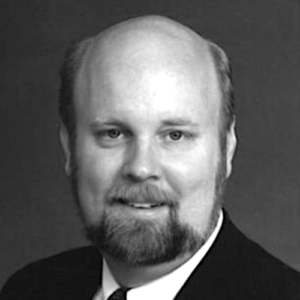
Wes Simpson Wes Simpson
President,
Telecom Product Consulting

Video: RIST Pre-Shared Key Encryption

An important factor when sending production video feeds and other media over the internet for most people is encryption. When distributing to the end user, it’s different, but for contribution having the assurance that no-one else can view the video is very reassuring to all parties even when the content doesn’t necessitate it. RIST has been in development for a while and has grown beyond the simple profile which only dealt with packet loss. Now with the main profile, encryption is possible; there are actually two ways to encrypt. One uses DTLS which is the UDP-based equivalent of the same TLS encryption that https:// websites use, the other uses pre-shared keys (PSK).

Sergio Ammirata from DVEO starts the talk by introducing the main profile and the use of GRE tunnels. The use of a tunnel from sender to receiver allows for a single connection to carry multiple channels of multiplexed data. Importantly. it also allows the encryption to happen to the tunnel rather than to each media stream separately.

The next section of the talk revises what DTLS is: part of the main profile providing TLS encryption to UDP. Given this is an encryption method, it’s important to realise it is not part of the data-loss recovery algorithms. Since DTLS is based on TLS, it will also need certificates. Just like websites you have the choice of having a self-signed certificate or one signed by a trusted authority. This means that you not only know that you are sending encrypted data, you are also sending it to a trusted computer, not someone unintended. Sergio takes us through the workflow of verifying the certificates highlighting, for instance, the requirement for a realtime clock otherwise the start and expiry dates in the certificates wouldn’t have any meaning.

With PSK, there is no authentication. It encrypts the whole of the GRE tunnel except for headers with an AES key related to the pre-shared passphrase. The encryption is changed periodically by an automatic process. It’s important to realise that because this is so deterministic, this can be used for bonded connections. When Sergio then looks at the data flow for using PSK, we see that that it is much simpler with many fewer handshakes.

As to when PSK is the route to take over using DTLS, one-to-many transmission is an obvious candidate but also where there is only one-way communication such as most satellite links. Sergio finishes the talk by looking at the use of FEC and taking questions from the floor.

Watch now!
Speaker

Sergio Ammirata Sergio Ammirata
CTO,
DVEO