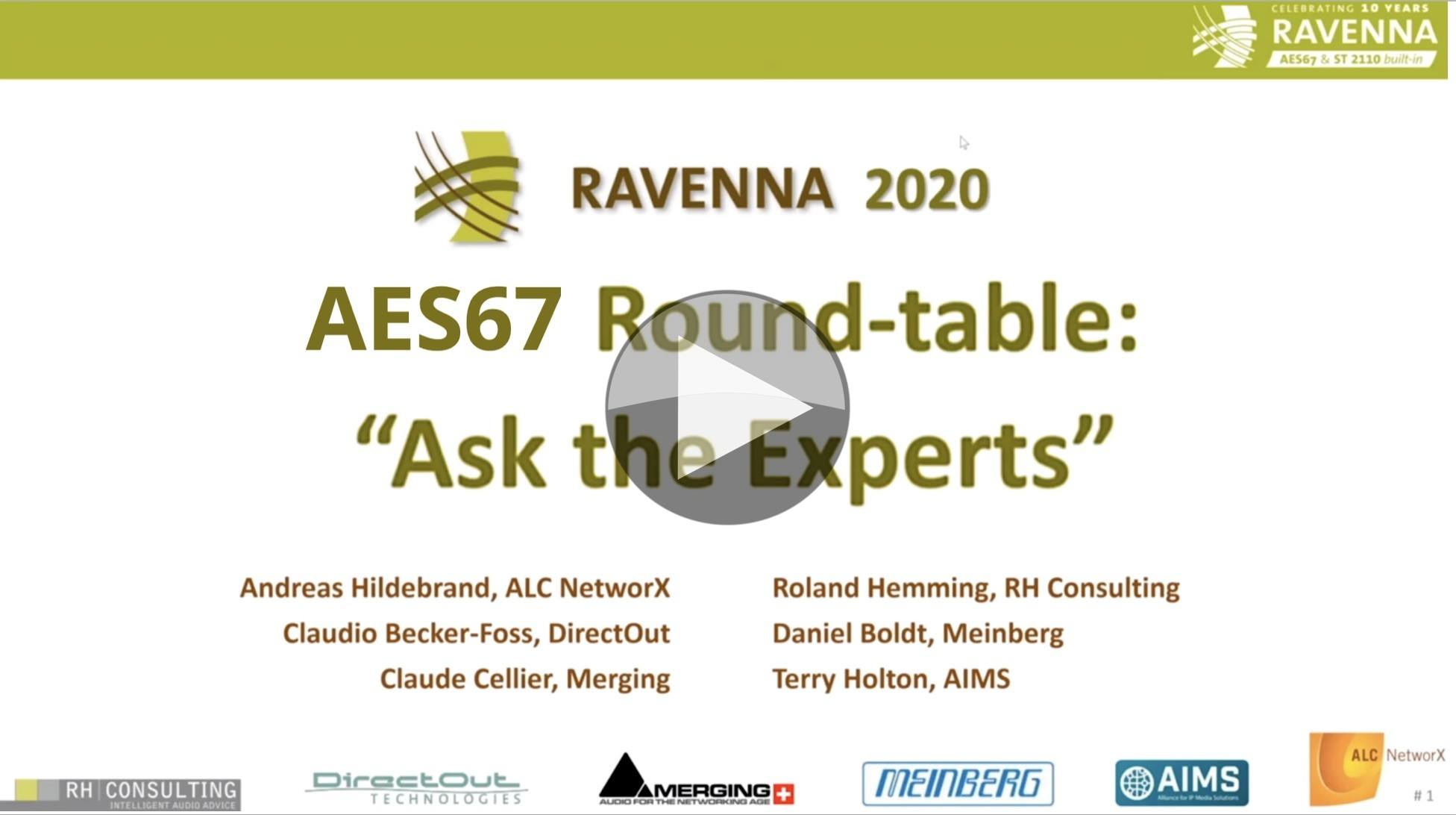
Video: Audio networking – ask anything you want!

It’s open season with these AES67 audio-over-Ip experts who are all the questions put to them on working with AES67. Not only was AES67 baked in to SMPTE ST 2110-30, it’s also a standard that brings compatability between Dante and RAVENNA as well as other AoIP technologies.

After a quick summary of what AES66 is, this talk quickly moves into answering these, and other questions:

  • How much bandwidth does stereo AES67 require?
  • Can multicast be used within Ravenna
  • Will there be a slipless switching/2022-7 style function?
  • Should receivers automatically adjust to original stream
  • Is it possible to avoid using PTP in an audio-only system?
  • Cost of PTP-capable switches
  • What’s the difference between Boundary Clocks and Transparent Clocks
  • Can AES67 go over the internet?
  • Tools for spotting problems
  • IPMX for Pro-AV update (See this talk)
  • Is NMOS ‘the answer’ for discovery and configuration?
  • Latency for Ravenna and AES67
  • New advancements in the PTP standard.

Watch now!
Speakers

Andreas Hildebrand Andreas Hildebrand
Evangelist,
ALC NetworX
Claude Cellier Claude Cellier
President & CEO
Merging Technologies SA
Claudio Becker-Foss
CTO,
DirectOut
Daniel Boldt Daniel Boldt
Head of Software Development,
Meinberg
Terry Holton Terry Holton
Audio subgroup Chairman,
AIMS
Roland Hemming Moderator: Roland Hemming
Audio Consultant
RH Consulting

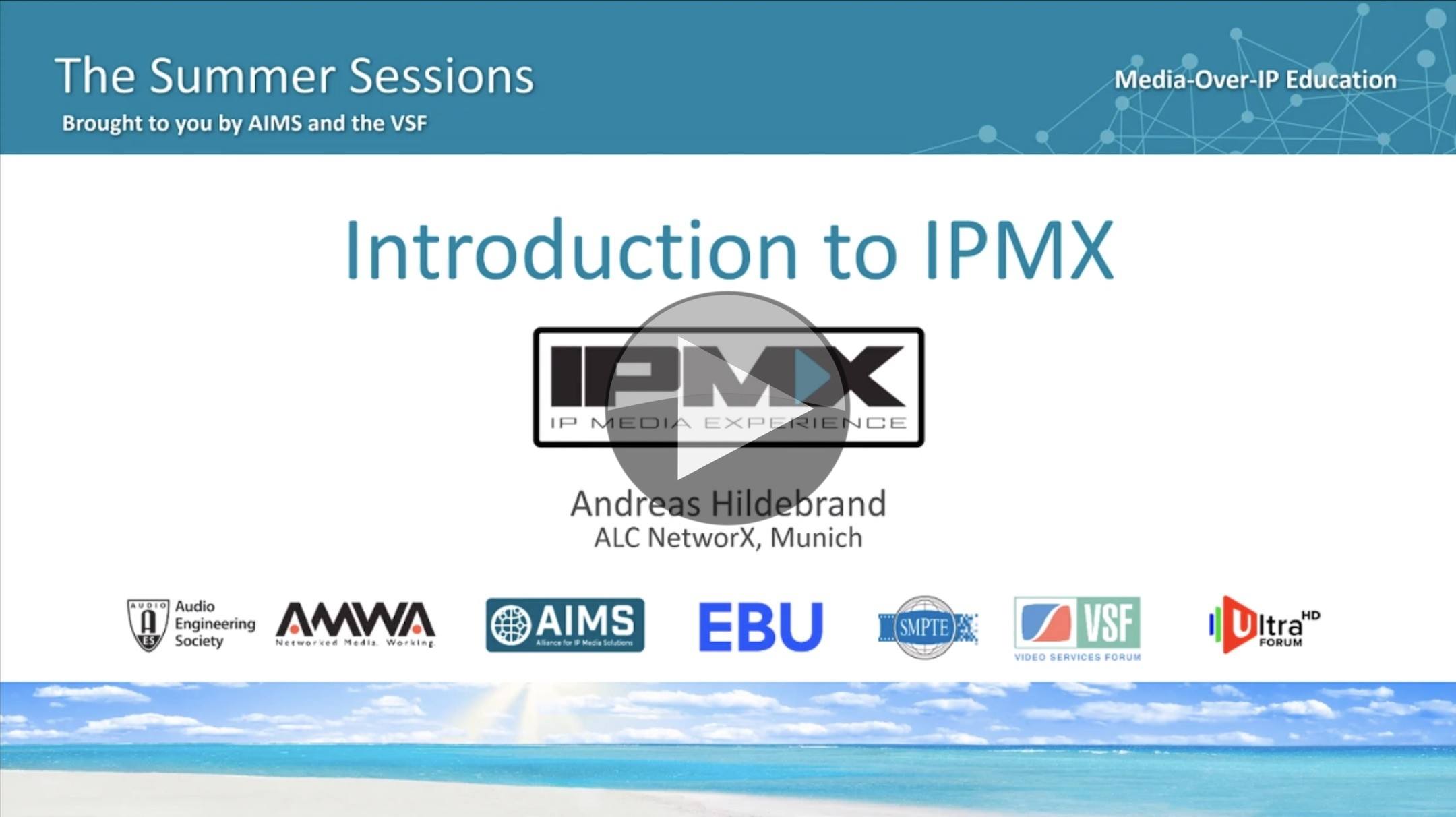
Video: Introduction to IPMX

The Broadcast Knowledge has documented over 100 videos and webinars on SMPTE ST 2110. It’s a great suite of standards but it’s not always simple to implement. For smaller systems, many of the complications and nuances don’t occur so a lot of the deeper dives into ST 2110 and its associated specifications such as NMOS from AMWA focus on the work done in large systems in tier-1 broadcasters such as the BBC, tpc and FIS Skiing for SVT.

ProAV, the professional end of the AV market, is a different market. Very few companies have a large AV department if one at all. So the ProAV market needs technologies which are much more ‘plug and play’ particularly those in the events side of the market. To date, the ProAV market has been successful in adopting IP technology with quick deployments by using heavily proprietary solutions like ZeeVee, SDVoE and NDI to name a few. These achieve interoperability by having the same software or hardware in each and every implementation.

IPMX aims to change this by bringing together a mix of standards and open specifications: SMPTE ST 2110, NMOS specs and AES. Any individual or company can gain access and develop a service or product to meet them.

Andreas gives a brief history of IP to date outlining how AES67, ST 2110, ST 2059 and the IS specifications, his point being that the work is not yet done. ProAV has needs beyond, though complementary to, those of broadcast.

AES67 is already the answer to a previous interoperability challenge, explains Andreas, as the world of audio over IP was once a purely federated world of proprietary standards which had no, or limited, interoperability. AES67 defined a way to allow these standards to interoperate and has now become the main way audio is moved in SMPTE 2110 under ST 2110-30 (2110-31 allows for AES3). Andreas explains the basics of 2110, AES, as well as the NMOS specifications. He then shows how they fit together in a layered design.

Andreas brings the talk to a close looking at some of the extensions that are needed, he highlights the ability to be more flexible with the quality-bandwidth-latency trade-off. Some ProAV applications require pixel perfection, but some are dictated by lower bandwidth. The current ecosystem, if you include ST 2110-22’s ability to carry JPEG-XS instead of uncompressed video allows only very coarse control of this. HDMI, naturally, is of great importance for ProAV with so many HDMI interfaces in play but also the wide variety of resolutions and framerates that are found outside of broadcast. Work is ongoing to enable HDCP to be carried, suitably encrypted, in these systems. Finally, there is a plan to specify a way to reduce the highly strict PTP requirements.

Watch now!
Speaker

Andreas Hildebrand Andreas Hildebrand
Evangelist,
ALC NetworX

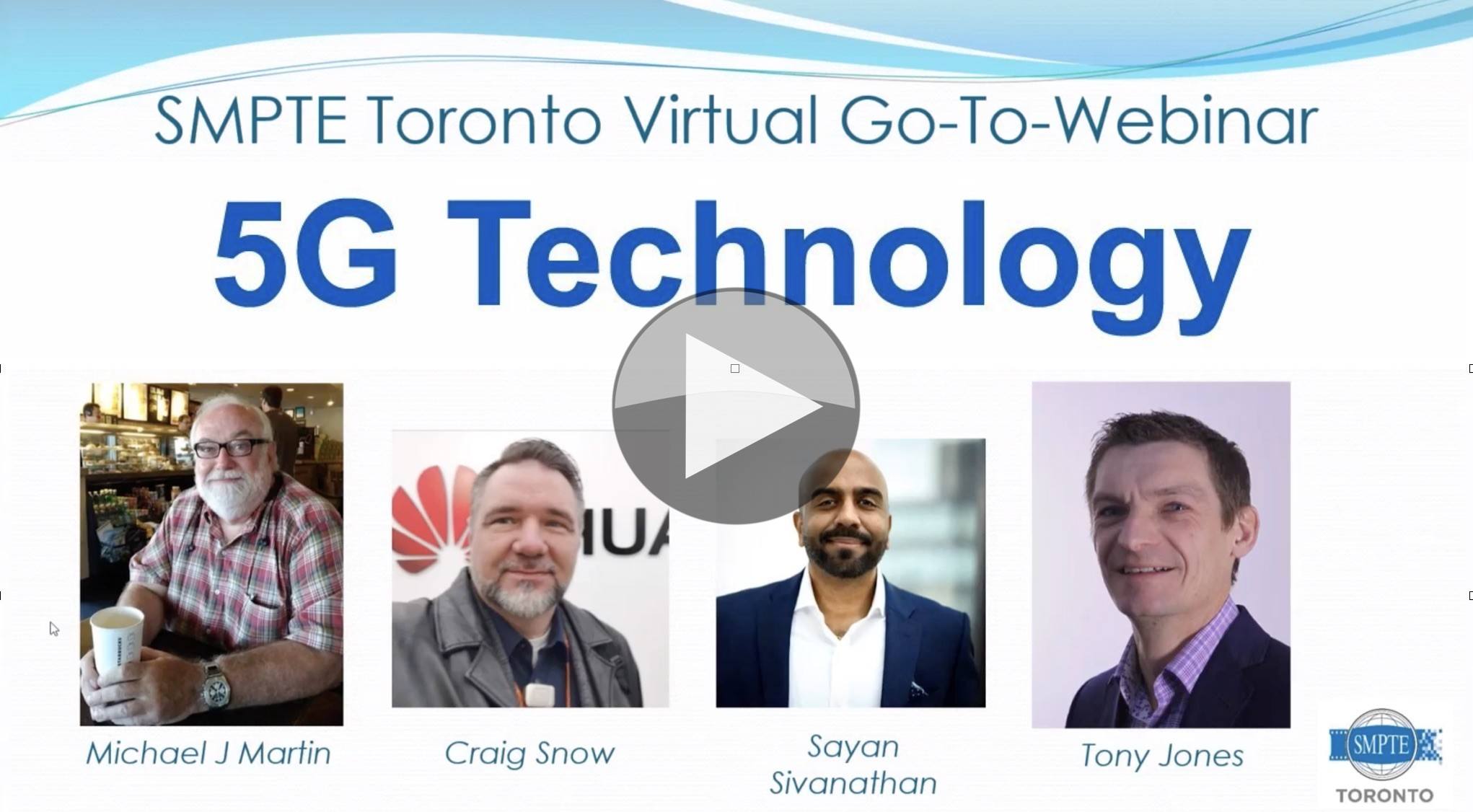
Video: 5G Technology

5G seems to offer so much, but there is a lot of nuance under the headlines. Which of the features will telcos actually provide? When will the spectrum become available? How will we cope with the new levels of complexity? Whilst for many 5G will simply ‘work’, when broadcasters look to use it for delivering programming, they need to look a few levels deeper.

In this wide-ranging video from the SMPTE Toronto Section, four speakers take us through the technologies at play and they ways they can be implemented to cut through the hype and help us understand what could actually be achieved, in time, using 5G technology.

Michael J Martin is first up who covers topics such as spectrum use, modulation, types of cells, beam forming and security. Regarding spectrum, Michael explains that 5G uses three frequency bands, the sub 1GHz spectrum that’s been in use for many years, a 3Ghz range and a millimetre range at 26Ghz.

“It’s going to be at least a decade until we get 5G as wonderful as 4G is today.”

Michael J Martin
Note that some countries already use other frequencies such as 1.8GHz which will also be available.The important issue is that the 26Ghz spectrum will typically not be available for over a year, so 5G roll-out starts in some of the existing bands or in the 3.4Ghz spectrum. A recurring theme in digital RF is the use of OFDM which has long been used by DVB and has been adopted by ATSC 3.0 as their modulation, too. OFDM allows different levels of robustness so you can optimise reach and bandwidth.

Michael highlights a problem faced in upgrading infrastructure to 5G, the amount of towers/sites and engineer availability. It’s simply going to take a long time to upgrade them all even in a small, dense environment. This will deal with the upgrade of existing large sites, but 5G provides also for smaller cells, (micro, pico and femto cells). These small cells are very important in delivering the millimetre wavelength part of the spectrum.

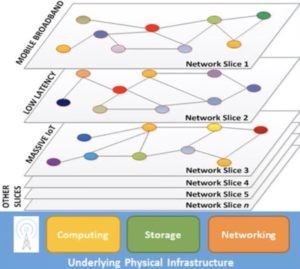
Network Slicing
Source: Michael J. Martin, MICAN Communications

We look at MIMO and beam forming next. MIMO is an important technology as it, effectively, collects reflected versions of the transmitted signals and processes them to create stronger reception. 5G uses MIMO in combination with beam forming where the transmitter itself electronically manipulates the transmitter array to focus the transmission and localise it to a specific receiver/number of receivers.

Lastly, Michael talks about Network Slicing which is possibly one of the most anticipated features of 5G by the broadcast community. The idea being that the broadcaster can reserve its own slice of spectrum so when sharing an environment with 30,000 other receivers, they will still have the bandwidth they need.

Our next speaker is Craig Snow from Huawei outlines how secondary networks can be created for companies for private use which, interestingly, partly uses separate frequencies from public network. Network slicing can be used to separate your enterprise 5G network into separate networks fro production, IT support etc. Craig then looks at the whole broadcast chain and shows where 5G can be used and we quickly see that there are many uses in live production as well as in distribution. This can also mean that remote production becomes more practical for some use cases.

Craig moves on to look at physical transmitter options showing a range of sub 1Kg transmitters, many of which have in-built Wi-Fi, and then shows how external microwave backhaul might look for a number of your buildings in a local area connecting back to a central tower.

Next is Sayan Sivanathan who works for Bell Mobility and goes in to more detail regarding the wider range of use cases for 5G. Starting by comparing it to 4G, highlighting the increased data rates, improved spectrum efficiency and connection density of devices, he paints a rosy picture of the future. All of these factors support use cases such as remote control and telemetry from automated vehicles (whether in industrial or public settings.)  Sayan then looks at the deployment status in the US, Europe and Korea. He shows the timeline for spectrum auction in Canada, talks through photos of  5G transmitters in the real world.

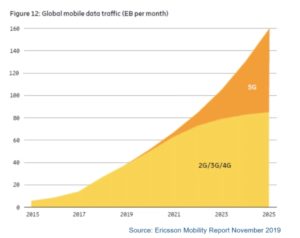
Global Mobile Data Traffic (Exabytes per month)
Source: Ericsson Mobility Report, Nov 2019

Finishing off today’s session is Tony Jones from MediaKind who focuses in on which 5G features are going to be useful for Media and Entertainment. One is ‘better video on mobile’. Tony picks up on a topic mentioned by Michael at the beginning of the video: processing at the edge. Edge processing, meaning having compute power at the closest point of the network to your end user allows you to deliver customised manifest and deal with rights management with minimal latency.

Tony explains how MediaKind worked with Intel and Ericsson to deliver 5G remote production for the 2018 US Open. 5G is often seen as a great way to make covering golf cheaper, more aesthetically pleasing and also quicker to rig.

The session ends with a Q&A

Watch now!
Speakers

Michael J Martin Michael J Martin
MICAN Communications
Blog: vividcomm.com
Tony Jones Tony Jones
Principal Technologist
MediaKind Global
Craig Snow Craig Snow
Enterprise Accounts Director,
Huawei
Sayan Sivanathan Sayan Sivanathan
Senior Manager – IoT, Smart Cities & 5G Business Development
Bell Mobility