Video: Designing and Utilising SMPTE 2110 for Broadcast: Opportunities and Challenges

A meeting of experienced minds here at the Pittsburgh SMPTE section talking about the opportunities and challenges of ST-2110. Phil Myers from Lawo talks optimistically about the challenges that can and often have been solved in implementing 2110 whether that be network infrastructure or timing, giving a good primer on the whole topic as he starts the session.

Hugo Gaggioni from Sony, talks about NMOS, explaining what AMWA does and the difference between their IS-04,05 and 06 specifications.

Karl Kuhn from Tektronix then discusses packet pacing, PTP and network architectures. He then looks at how to monitor PTP and see it is working well.

With the panel session at the end, joined by Dan Turk from NEP, there is a free-ranging discussion covering some of the following topics:

  • Control of IP networks
  • The limits of IP
  • Multicast traffic
  • Network Architecture
  • True non-blocking switches
  • Break-even points of IP systems
  • Split essences & dropping blanking
  • Network planning for UHD
  • Handling loss of network on PTP implementations
    plus much more!

Watch now!

Speakers

Phil Myers Phil Myers
Senior Director, IP Systems,
Lawo
Karl Kuhn Karl Kuhn
Senior Field Video Applications Engineer,
Tektronix
Hugo Gaggioni Hugo Gaggioni
CTO, Broadcast and Production Systems Division
Sony
Dan Turk Dan Turk
Chief Engineer, Mobile Units
NEP

Video: Enhanced Redundancy of ST 2059-2 Time Transfer over ST 2022-7 Redundant Networks

We’re all starting to get the hang of the basics: that PTP is the new Black and Burst, that we still need sync to make studios work and that PTP (IEEE1588) is standardised under ST 2059 for use in the broadcast industry. So given its importance, how can we make it redundant?

Thomas Kernen from Mellanox and Chair within the STMPE standards community takes about his real-lift work on implementing PTP with an eye on redundancy methods

Thomas covers the following and more:

  • Whether 2022-7 works for PTP
  • BMCA Redundancy Model
  • Multiple Grand master use
  • Adjusting to dynamic variations in timing feeds
  • IEEE 1588 v2.1
  • Timing Differences in basic networks

Speakers

Thomas Kernen Thomas Kernen
Staff Software Architect, Mellanox Technologies
Co-chair SMPTE 32NF Network Facilities Technology Committee

Video: IP for Media Webcast Part I

TV Technology talks to Wes Simpson to find out build up full view of IP from the basics of ‘why are we moving to IP’ up to thoughts on network architecture and cloud infrastructure.

This is the first of two videos and will leave you with a broad understanding of the basics of how IP is used and implemented in broadcast covering audio and compressed and uncompressed video.

Wes’s extensive topic list:

  • Why people are moving to IP
  • Applications for IP Video
  • Pros and cons
  • Standards available
  • New workflows available
  • Mixing IP and SDI
  • OTT delivery, ATSC 3.0 delivery
  • Network basics & architectures
  • Multicast
  • Timing and Synchronisation (PTP)
  • Cloud concepts
  • CDNs
  • Ad Insertion

 
Watch now!


Speakers

Wes Simpson Wes Simpson
President,
Telecom Product Consulting
Tom Butts Tom Butts
Content Director,
TV Technology

Video: ST 2110 over WAN

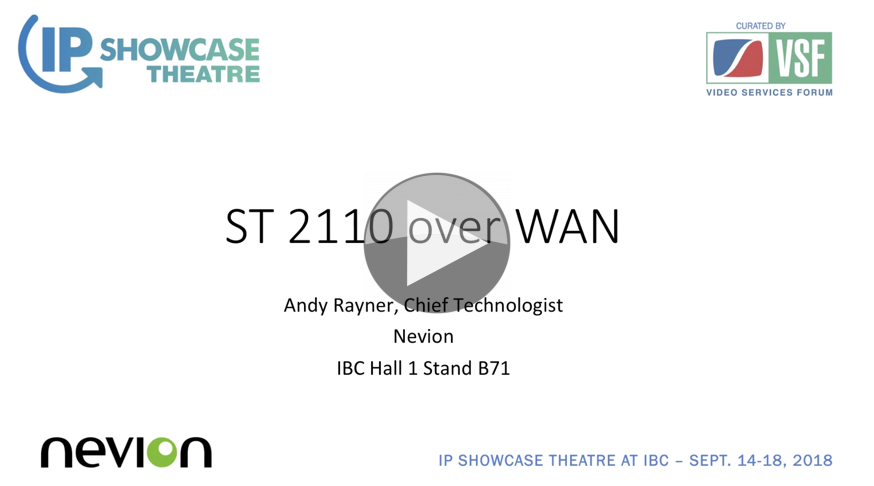
Andy Rayner from Nevion looks at using SMPTE ST 2110 on a Wide Area Network (WAN).

While using ST 2110 is a much discussed topic in the studio or within a building, there are extra difficulties in putting it between buildings, cities and countries with some saying it shouldn’t even be done. Here, Andy examines how you can do it whilst acknowledging the industry still has some decisions to make.

Topics discussed include:

  • SMPTE ST 2022-7 – dual flows
  • FEC use on ST 2110
  • Flow Trunking
  • Conversions to and from 2110 and 2022-6
  • Light/Mezzanine Compression
  • PTP Trunking and GPS-locked PTP
  • Multiple Timing Domains
  • Discovery & Control between buildings

Watch now!

Speaker

Andy Rayner Andy Rayner,
Chief Technologist,
Nevion