
Video: Live Production Forecast: Cloudy for the Foreseeable Future

Our ability to work remotely during the pandemic is thanks to the hard work of many people who have developed the technologies which have made it possible. Even before the pandemic struck, this work was still on-going and gaining momentum to overcome more challenges and more hurdles of working in IP both within the broadcast facility and in the cloud.

SMPTE’s Paul Briscoe moderates the discussion surrounding these on-going efforts to make the cloud a better place for broadcasters in this series of presentation from the SMPTE Toronto section. First in the order is Peter Wharton from TAG V.S. talking about ways to innovate workflows to better suit the cloud.

Peter first outlines the challenges of live cloud production, namely keeping latency low, signal quality high and managing the high bandwidths needed at the same time as keeping a handle on the costs. There is an increasing number of cloud-native solutions but how many are truly innovating? Don’t just move workflows into the cloud, advocates Peter, rather take this opportunity to embrace the cloud.

Working with the cloud will be built on new transport interfaces like RIST and SRT using a modular and open architecture. Scalability is the name of the game for ‘the cloud’ but the real trick is in building your workflows and technology so that you can scale during a live event.
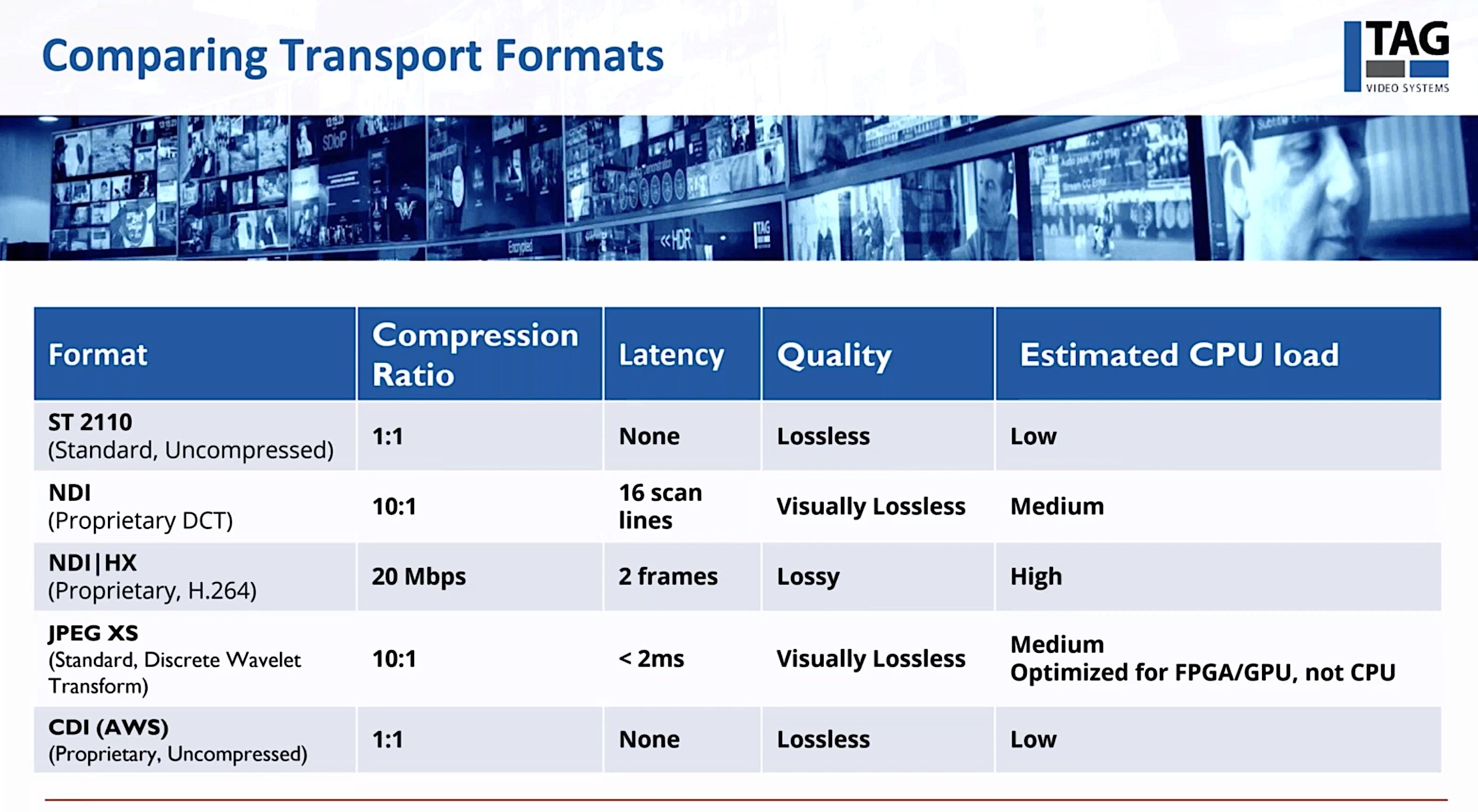
Source: TAG V.S.

There are still obstacles to be overcome. Bandwidth for uncompressed video is one, with typical signals up to 3Gbps uncompressed which then drives very high data transfer costs. The lack of PTP in the cloud makes ST 2110 workflows difficult, similarly the lack of multicast.

Tackling bandwidth, Peter looks at the low-latency ways to compress video such as NDI, NDI|HX, JPEG XS and Amazon’s lossless CDI. Peter talks us through some of the considerations in choosing the right codec for the task in hand.

Finishing his talk, Peter asks if this isn’t time for a radical change. Why not rethink the entire process and embrace latency? Peter gives an example of a colour grading workflow which has been able to switch from on-prem colour grading on very high-spec computers to running this same, incredibly intensive process in the cloud. The company’s able to spin up thousands of CPUs in the cloud and use spot pricing to create temporary, low cost, extremely powerful computers. This has brought waiting times down for jobs to be processed significantly and has reduced the cost of processing an order of magnitude.

Lastly Peter looks further to the future examining how saturating the stadium with cameras could change the way we operate cameras. With 360-degree coverage of the stadium, the position of the camera can be changed virtually by AI allowing camera operators to be remote from the stadium. There is already work to develop this from Canon and Intel. Whilst this may not be able to replace all camera operators, sports is the home of bleeding-edge technology. How long can it resist the technology to create any camera angle?
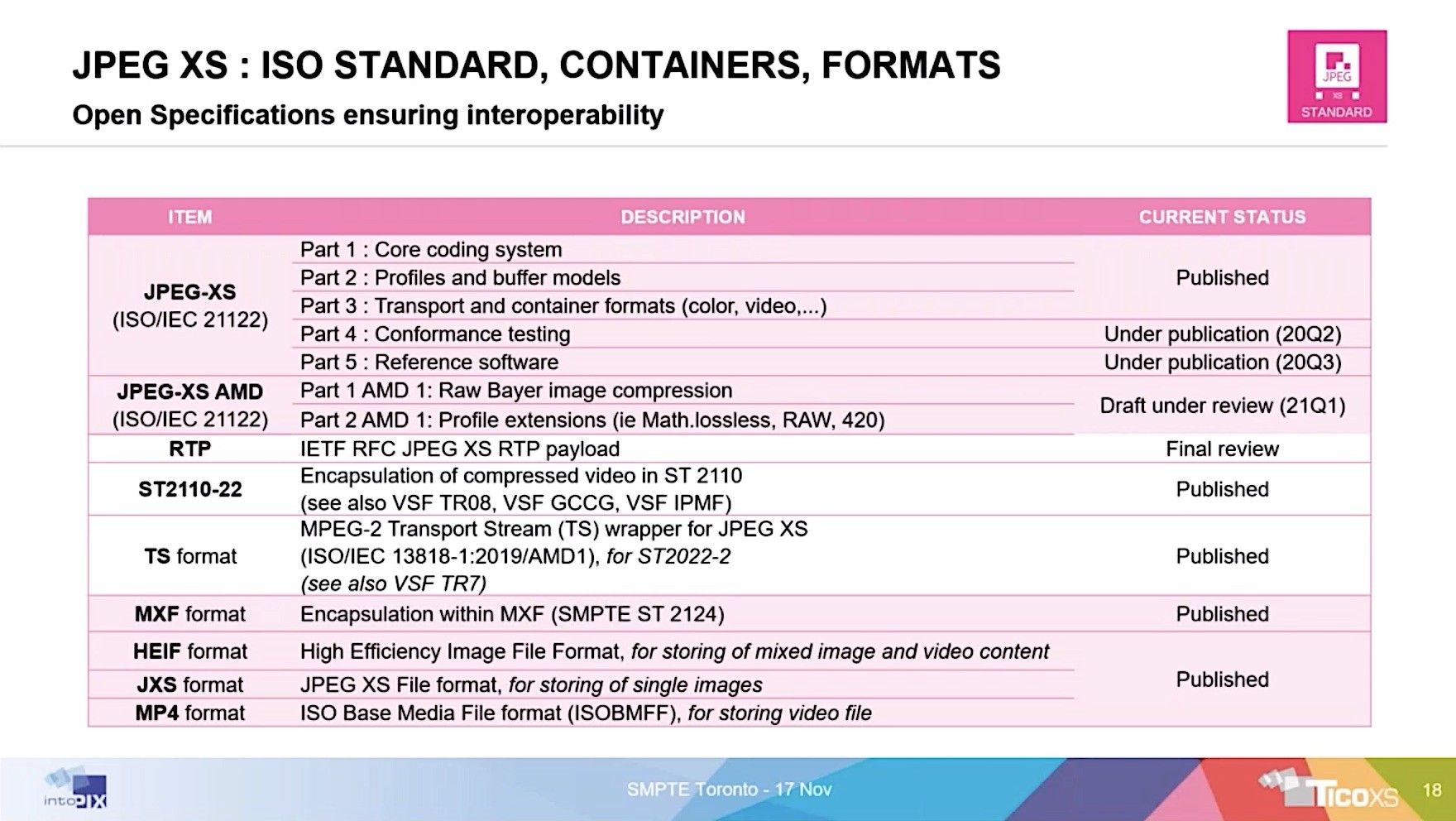
Source: intoPIX

Jean-Baptiste Lorent is next from intoPIX to explain what JPEG XS is. A new, ultra-low-latency, codec it meets the challenges of the industry’s move to IP, its increasing desire to move data rather than people and the continuing trend of COTS servers and cloud infrastructure to be part of the real-time production chain.

As Peter covered, uncompressed data rates are very high. The Tokyo Olympics will be filmed in 8K which racks up close to 80Gbps for 120fps footage. So with JPEG XS standing for Xtra Small and Xtra Speed, it’s no surprise that this new ISO standard is being leant on to help.

Tested as visually lossless to 7 or more encode generations and with latency only a few lines of video, JPEG XS works well in multi-stage live workflows. Jean-Baptiste explains that it’s low complexity and can work well on FPGAs and on CPUs.

JPEG XS can support up to 16-bit values, any chroma and any colour space. It’s been standardised to be carried in MPEG TSes, in SMPTE ST 2110 as 2110-22, over RTP (pending) within HEIF file containers and more. Worst case bitrates are 200Mbps for 1080i, 390Mbps for 1080p60 and 1.4Gbps for 2160p60.

Evolution of Standards-Based IP Workflows Ground-To-Cloud

Last in the presentations is John Mailhot from Imagine Communications and also co-chair of an activity group at the VSF working on standardising interfaces for passing media place to place. Within the data plane, it would be better to avoid vendors repeatedly writing similar drivers. Between ground and cloud, how do we standardise video arriving and the data you need around that. Similarly standardising new technologies like Amazon’s CDI is important.

John outlines the aim of having an interoperability point within the cloud above the low-level data transfer, closer to 7 than to 1 in the OSI model. This work is being done within AIMS, VSF, SMPTE and other organisations based on existing technologies.

Q&A
The video finishes with a Q&A and includes comments from AWS’s Evan Statton whose talk on CDI that evening is not part of this video. The questions cover comparing NDI with JPEG XS, how CDI uses networking to achieve high bandwidths and high reliability, the balance between minimising network and minimising CPU depending on workflow, the increasingly agile nature of broadcast infrastructure, the need for PTP in the cloud plus the pros and cons of standards versus specifications.

Watch now!
Speakers

Peter Wharton Peter Wharton
Director Corporate Strategy, TAG V.S.
President, Happy Robotz
Vice President of Membership, SMPTE
Jean-Baptiste Lorent Jean-Baptiste Lorent
Director Marketing & Sales,
intoPIX
John Mailhot John Mailhot
Co-Chair Cloud-Gounrd-Cloud-Ground Activity Group, VSF
Directory & NMOS Steering Member, AMWA
Systems Architect for IP Convergence, Imagine Communcations
Paul Briscoe Moderator: Paul Briscoe
Canadian Regional Governor, SMPTE
Consultant, Televisionary Consulting
Evan Statton Evan Statton
Principal Architect, Media & Entertainment
Amazon Web Services

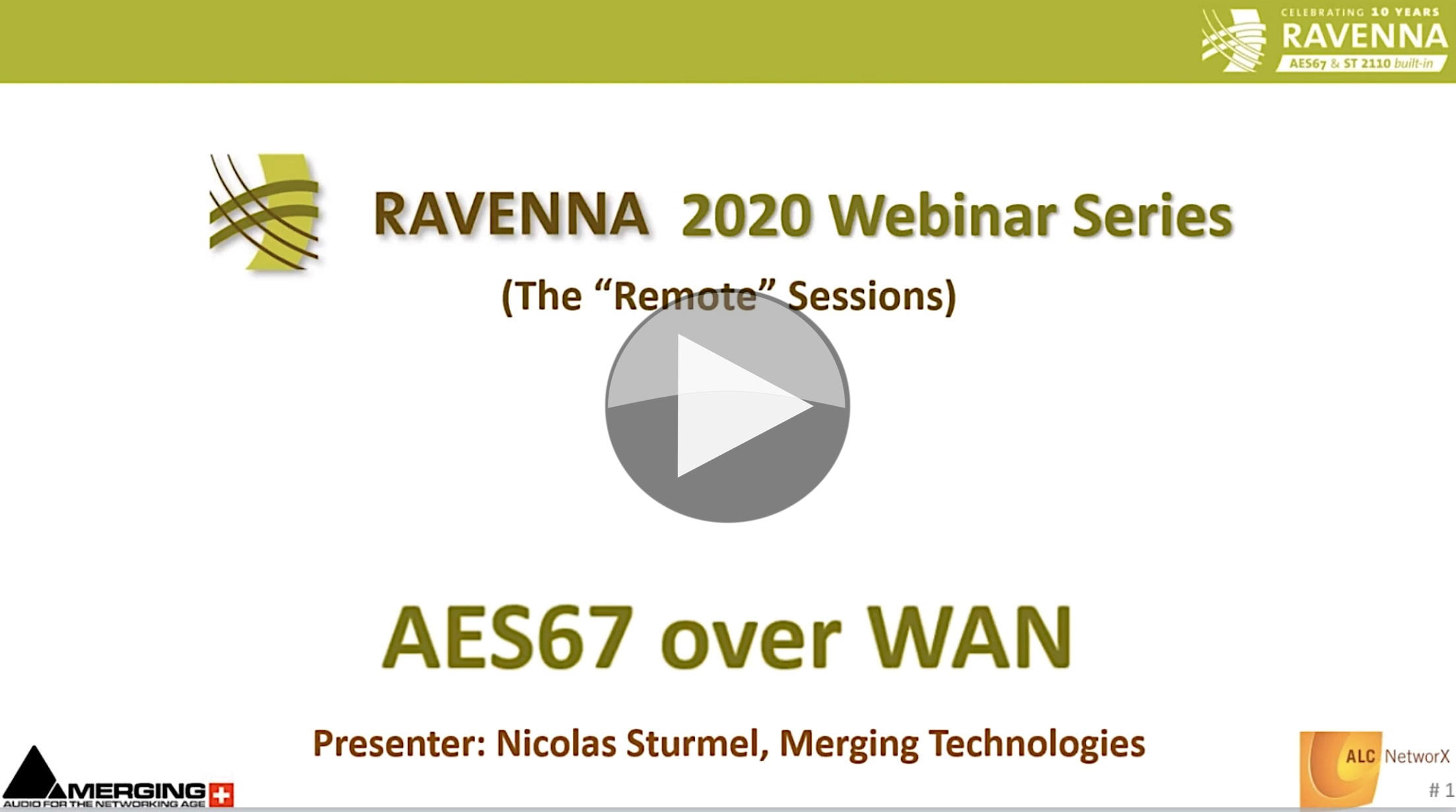
Video: AES67 over WAN

Deeply embedded in the audio industry and adopted into SMPTE ST 2110, AES67 workflows surround us. Increasingly our workflows are in multiple locations so moving AES67 on the WAN and the internet is essential. If networks were always perfect, this would be easy but as that’s not the case, this RAVENNA talk examines what the problems are and how to solve them.

Andreas Hildebrand introduces the video with an examination of how the WAN, whether that’s a company’s managed wide area network or the internet at large, is different from a LAN. Typical issues are packet loss, varying latency meaning the packets arrive with jitter, lack of PTP and multicast. With this in mind, Nicolas Sturmel from Merging Technologies takes the reins to examine the solutions.

Nicolas explains the typically EBU Tech 3326 (also known as ACIP) is used for WAN contribution which specifies how a sender and receiver communicate and the codecs to be used. Although PCM is available, many codecs such as AptX are also prescribed for use. Nicolas says that ACIP is great for most applications but if you need low-latency, precise timing and PCM-quality staying AES67 may be the best policy, even over the WAN.

Having identified your AES6-over-WAN workflow, the question is how to pull it off. Nicolas looks at three methods, one is FEC whereby you are constantly sending redundant data. FEC can send up to around 25% extra data so that if any is lost, the extra information sent can be leveraged to determine the lost values and reconstruct the stream. This is can work well but requires sending this extra data constantly therefore putting up your bandwidth. It can also only deal with certain losses requiring them to be of a short duration.

Instead of FEC, you can use RIST, SRT or a similar re-transmission technology. These will actively recover any lost packets and have the benefit that you only transmit more data when you have lost data. Lastly, he mentions SMPTE ST 2022-7 which uses two paths of identical data to cover losses in any one of them. Although this is 100% extra data, the benefit is that it can deal with any type of loss including a complete path failure which neither of the others can do. It is, however possible to combine FEC or RIST with a 2022-7 workflow so you can have two levels of protection.

Timing over the WAN is not ideal as PTP loses accuracy over long-latency links and it assumes symmetry. On the internet, it’s possible to get links where the latency is longer in one direction than the other. An easy, though potentially costly, workaround for distributing PTP over the WAN is to use GPS, GLONASS or similar to synchronise grandmaster clocks at each location.

Watch now!
Speakers

Nicolas Sturmel Nicolas Sturmel
Product Manager & Senior Technologist
Merging Technologies
Andreas Hildebrand Andreas Hildebrand
RAVENNA Evangelist,
ALCNetworx

Video: HTTP over QUIC is the next generation

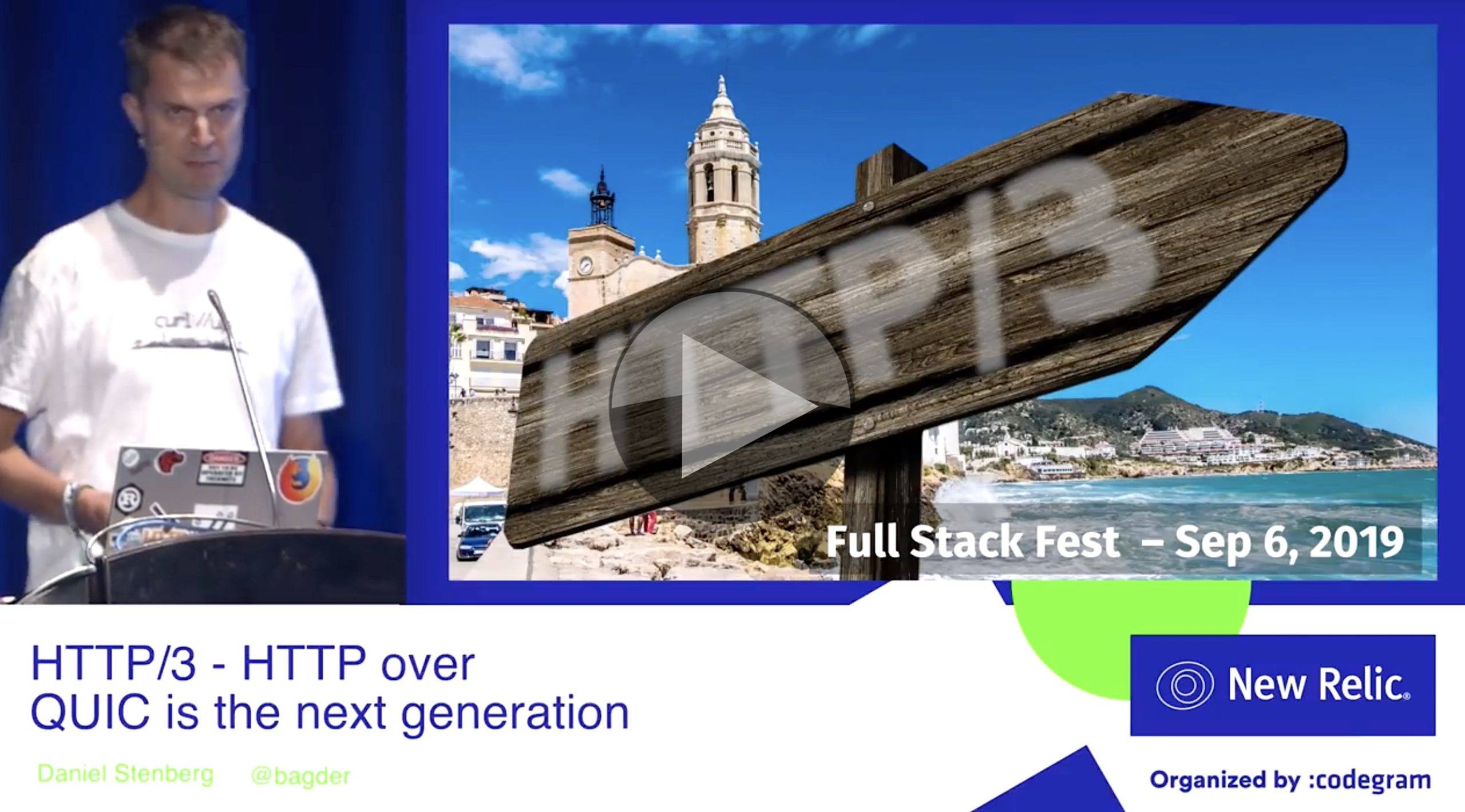
There’s a lot to like about HTTP/3 from encryption as standard, faster set-up time, better compression and promises better throughput by removing head-of-line blocking. A new protocol making its way through the IETF and based on QUIC, this could have a real impact on anyone involved in streaming.

wolfSSL’s Daniel Stenberg and cURL maintainer, talks to us about HTTP/3 but starts at the beginning with HTTP 1 and 1/1. He outlines some of the issues we had in 1997 such as head-of-line blocking and ephemeral TCP connections. Zooming forward to 2005, HTTP/2 comes on the scene with a single HTTP connection, thus removing the significant overhead of ephemeral TCP connections. HTTP/2 went with a ‘streamed’ connection and could have multiple such streams but one thing that wasn’t solved was head-of-line blocking.

Before moving beyond HTTP/2, Daniel describes the problems that have set in due to ‘ossification’, that is to say, that the routers that time forgot which are still on very old, and often buggy TCP implementations. Innovating is very difficult if replacing the TCP within even a subset of boxes would mean I wasn’t able to send my website globally.

Addressing this ‘ossification’ issue, QUIC has stepped in. Developed on UDP instead of TCP QUIC solves a number of problems. First off, moving from TCP to UDP allows the protocol to live in userspace making it easier to update. Working on UDP instead of TCP means that the protocol regains control of the retransmissions allowing for something more efficient than TCP’s strict acknowledgement rules.

So QUIC becomes the transport layer of HTTP/3. Freeing ourselves from TCP, Daniel explains, allows us to remove the TCP head-of-line blocking problem. HTTP/3 on QUIC brings with it faster handshakes and a connection ID. This connection ID allows you to change IP addresses and still maintain your connection which is a significant improvement on what has gone before. Daniel continues by explaining more benefits of QUICK and HTTP/3 such as its encryption and the ability to have multiple streams.

Daniel finishes up outlining eight challenges for HTTP/3. These include the fact that up to 7% of QUICK attempts fail, dealing with ‘fall back’ algorithms, UDP having seen historically low usage and are less optimised as well as the downsides of userland protocol stacks being that it’s harder to get a standard.

Watch now!
Download the presentation
Speakers

Daniel Stenberg Daniel Stenberg
curl master, wolfSSL
main author,

Video: RIST Unfiltered – Q&A Session

RIST is a protocol which allows for reliable streaming over lossy networks like the internet. Whilst many people know that much, they may not know more and may have questions. Today’s video aims to answer the most common questions. For a technical presentation of RIST, look no further than this talk and this article

Kieran Kunhya deals out the questions to the panel from the RIST Forum, RIST members and AWS. Asking:
Does RIST need 3rd party equipment?
Is there an open-source implementation of RIST?
Whether there are any RIST learning courses?
as well as why companies should use RIST over SRT.
RIST, we hear is based on RTP which is a very widely deployed technology for real-time media transport and is widely used for SMPTE 2022-2 and 6 streams, SMPTE 2110, AES67 and other audio protocols. So not only is it proven, but it’s also based on RFCs along with much of RIST. SRT, the panel says, is based on the UDT file transfer protocol which is not an RFC and wasn’t designed for live media transport although SRT does perform very well for live media.

“Why are there so many competitors in RIST?” is another common question which is answered by talking about the need for interoperability. Fostering widespread interoperability will grow the market for these products much more than it would with many smaller protocols. “What new traction is RIST getting?” is answered by David Griggs from AWS who says they are committed to the protocol and find that customers like the openness of the protocol and are thus willing to invest their time in creating workflows based on it. Adi Rozenberg lists many examples of customers who are using the technology today. You can hear David Griggs explain RIST from his perspective in this talk.

Other questions handled are the licence that RIST is available under and the open-source implementations, the latency involved in using RIST and whether it can carry NDI. Sergio explains that NDI is a TCP-based protocol so you can transmit it by extracting UDP out of it, using multicast or using a VizRT-tool for extracting the media without recompressing. Finally, the panel looks at how to join the RIST Activity Group in the VSF and the RIST Forum. They talk about the origin of RIST being in an open request to the industry from ESPN and what is coming in the upcoming Advanced Profile.

Watch now!
Speakers

Rick Ackermans Rick Ackermans
RIST AG Chair,
Director of RF & Transmission Engineering, CBS Television
David Griggs David Griggs
Senior Product Manager, Media Services,
AWS Elemental
Sergio Ammirata Sergio Ammirata
RIST AG Member,
Chief Science Officer, SipRadius
Adi Rozenberg Adi Rozenberg
RIST Forum Director
AG Member, Co-Founder & CTO, VideoFlow
Ciro Noronha Ciro Noronha
RIST Forum President and AG Member
EVP of Engineering, Cobalt Digital
Paul Atwell Paul Atwell
RIST Forum Director,
President, Media Transport Solutions
Wes Simpson Wes Simpson
RIST AG Co-Chair,
President & Founder, LearnIPvideo.com
Kieran Kunhya Kieran Kunhya
RIST Forum Director
Founder & CEO, Open Broadcast Systems